Kansas City Star | July 1, 2015
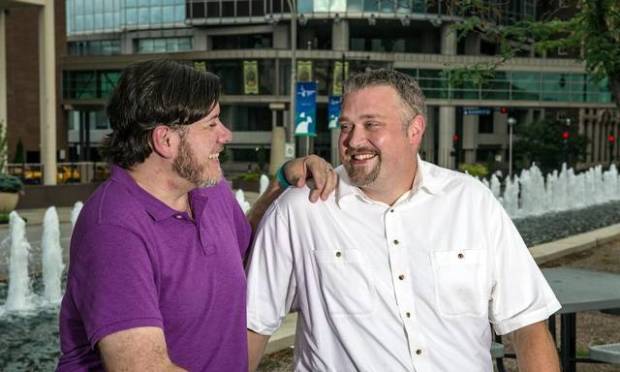
Engaged Kansas City couple Chris Piel and Jason Hoke have been planning an Iowa wedding for the past year.
But last Friday, Piel watched the U.S. Supreme Court rule that marriage was a right for same-sex couples. He was glued to his computer at work, constantly refreshing the Supreme Court blog, and even postponed a 9 a.m. meeting.
After two hours of celebratory text messages and Facebook posts, Piel and Hoke changed their wedding plans and decided to host their wedding at home in Kansas City.
“Our friends and Jason’s family are here,” Piel said. “It just makes more sense to have it here in Missouri.”
Piel, a human resources specialist, hopes to invite at least 250 people, while Hoke, an account manager, prefers to keep the guest list down to 100 names. Either way, the couple are bringing a big party to Kansas City.
That’s good news for local businesses. It’s also good news for the national wedding industry: People spend $51 billion annually across the U.S.
A study conducted at the Williams Institute at UCLA forecasts that the country could see an additional $2.6 billion spent on nuptials. In addition, LGBT weddings could support 13,058 jobs in the wedding industry.
The study predicts that Kansas will see more than 2,000 same-sex marriages in the next three years, which could add $14.1 million to the state’s economy. Missouri has an even higher population of gay couples, which means 5,000 weddings could generate $36.3 million.
Engaged couples spend a considerable amount of money on event planners, venues, florists, catering and wedding attire. The average local wedding costs $22,992, according to The Wedding Report, and people from the Kansas City metro area spend almost $300 million on weddings.
But until now, same-sex weddings did not play a significant role in this statistic. Many couples either left the state to wed or decided to put off marriage altogether.
Some same-sex couples actually have hosted local — and legal — weddings in the past seven months. Jackson County became one of the few Missouri counties to allow gay marriage in November.
“We’ve already legally married five or six same-sex couples at our business,” said Kathryn Hogan, owner of The Vow Exchange, a downtown wedding venue in Kansas City.
Even so, many gay couples remained cautious until the Supreme Court made its decision. Hogan suspects these couples delayed their weddings for fear that Jackson County’s legal means to issue marriage licenses might be reversed.
During that time, “we saw a lot of couples going up to Iowa to get married,” said Dan Meiners, owner of Studio Dan Meiners and member of the Mid-America Gay & Lesbian Chamber of Commerce. The organization advocates for businesses owned by members of the LGBT community.
Seven months after Jackson County started issuing licenses, Hogan said, gay and lesbian couples are “breathing a sigh of relief.” The Supreme Court ruling solidifies their right to marry, which means no more holding off wedding ceremonies because of uncertainty.
Some business owners admit that they’re not entirely sure whether to expect a boost in clients, a gradual increase, or any change in business at all.
“From our perspective, this is a very good thing,” said Jessica Corbett, owner of Hitched Planning and Floral. “It will be interesting to see how different businesses respond.”
But other business owners are more optimistic. Meiners is expecting to see more couples stay in Kansas City and invest in the local wedding industry. He predicts the area will see a “large surge” in same-sex weddings.
“I’m very, very happy,” said Meiners, who has both a personal and professional stake in the Supreme Court decision. “I can’t believe that this is happening in my lifetime.”
 Kasia Kovacs