In the wake of several big name failures, the industry seeks a solid Spanish language news model

Digital Content Next | 30 January 2020

2019 will be remembered as a turbulent year for Spanish-language news in the U.S. The New York TimesBuzzFeed News, the Huffington Post, and the Chicago Tribune all shut down their Spanish-language websites in a large blow to parts of the 59 million Spanish language speakers in the U.S.

However, as the old decade folded into the new year, national news outlets confirmed that they weren’t giving up on Spanish-language news. In the past two months, The Washington Post launched its first Spanish-language news podcast, El Washington Post, and USA Today started Hecho en USA, its series on Latino communities. As the new decade begins, the future of Spanish-language news in the U.S. remains a puzzle, difficult to piece together.

Revenue review

The reason for the failures of 2019 largely boil down to money. The Times, for instance, initially launched NYT en Español in early 2016 as a way to grow its international audience. This was part of an optimistic goal to generate $800 million in digital revenue by 2020. At the time, Donald Trump’s racist rhetoric was in full force. So, putting the Times’ journalism stamp on important issues south of the border was meant to be a significant step towards the outlet’s lofty aims.

The plan was to support NYT en Español with advertising revenue, along with the hope of turning readers into subscribers. But a little more than three years later, NYT en Español closed its Mexico City bureau. Despite a potential audience of 80 million people, the advertising dollars weren’t coming in, a Times spokesperson said when the website shut down in September. Nor were these readers subscribing. But according to NYT en Español’s founding editorial director Eli Lopez, the Times lacked a credible plan to monetize his team’s content.

In the wake of these ill-fated efforts, Spanish-speaking communities pay the price. More than 8,000 English-speaking news organizations currently serve approximately 250 million English speakers in the U.S. However, for the almost 59 million Spanish speakers – 10 million of whom don’t speak English well – only approximately 624 news outlets serve them.

When Tribune Publishing shut down Hoy Media, their Spanish-language newspaper in Chicago, in November, reporter Laura Rodríguez lamented the news that would no longer be reported for Chicago’s Latino and Hispanic communities.

Markets in need

“I’m seriously so angry and frustrated at the fact that the company decided to get rid of such an important platform for the Spanish-speaking community in Chicago,” Rodríguez tweeted. “I wrote so many stories no one else did — we had our space! Our Latino, Spanish-speaking community counted on us to tell their stories. Those that are often not told.”

While some of the nation’s largest outlets can afford to experiment, the same can’t be said for smaller organizations across the country. Statewide and citywide newsrooms have already faced crushing layoffs and decimated revenues in one of the hardest decades ever for journalism. And Spanish-speaking communities are among those that will suffer the most.

In New Mexico, where slightly more than one million Spanish speakers represent 49% of the state’s population, the Hispanic population is the most underserved. Despite having a long history with the Spanish language that dates back to before the Constitution, the state only has three Spanish-speaking news outlets. And they are all TV stations and all based in Albuquerque. Compare that to neighboring Arizona, home to a Hispanic population around double the size of New Mexico at more than two million. It is home to 17 Spanish-language outlets, more than five times the amount in New Mexico.

Size matters

At a time when local news has already suffered greatly and positive signs are few and far between (it’s estimated that more than 13,000 communities in the U.S. don’t have any local news coverage) is it too much to expect smaller and medium-sized outlets to launch Spanish-language offerings? Given that national outlets such as the New York Times can’t turn a profit from such investments, the answer for many local newsrooms with fewer resources may just be yes. Right now, it is too much.

Scott Brodbeck is just one local news editor who is familiar with the obstacles of running a local news website. Brodbeck is the founder and CEO of Local News Now, a network of hyperlocal news websites he launched in 2010 that serve markets in northern Virginia and Washington, D.C. With the shrinking advertising market for most media companies due to Google and Facebook’s dominance, financial uncertainty is just one reason why local news companies such as Brodbeck’s aren’t able to implement new products specifically for non-English speaking audiences.

“The biggest challenges are recruiting, training and retaining talented people; producing consistently excellent local journalism that attracts a large local audience; and growing sales to keep growing our organization,” Brodbeck said. “Given the challenges of just putting out our current news product, it would be unrealistic to try to do what we’re doing in a second language.”

Demanding demographics

America is undergoing a rapid change in demographic identity. According to Census projections, the Hispanic and Latino population represented just more than 17% of the U.S. population. By 2060, that population is predicted to be roughly 120 million people, or 28 percent. That’s why Brodbeck said that the best solution for local newsrooms in the future could be for them to focus on hiring reporters from diverse backgrounds. That would allow them to serve as many communities as possible.

“Having separate Spanish language brands may make sense for some of the largest news publishers. Smaller newsrooms would be better off putting their energies into developing robust hiring, training, and employee support practices, to cultivate a diverse workforce that can better serve all readers

News outlets continue to wrestle with how to serve diverse audiences. Thus, it might be down to schools and universities to take a proactive approach by preparing the next generation of journalists for the ever-changing media landscape.

One journalism school that’s already doing so is the Craig Newmark Graduate School of Journalism at CUNY. The school’s Spanish-language journalism program aims to train bilingual journalists to better cover issues important to Latino communities. This program could be a footprint for other journalism schools across the country to follow. It could also provide news outlets with a new generation of journalists to serve an increasingly diverse population.

Like many other aspects of an industry grappling with profitability and even survival, the future of Spanish-language news remains uncertain. And just as the industry experiments with reader engagement and revenue models, news organizations and universities are now exploring different methods of delivering Spanish-speaking news, such as podcasts and special series. With so many moving pieces, only one projection is relatively certain: the growing population of Spanish speakers in the U.S.
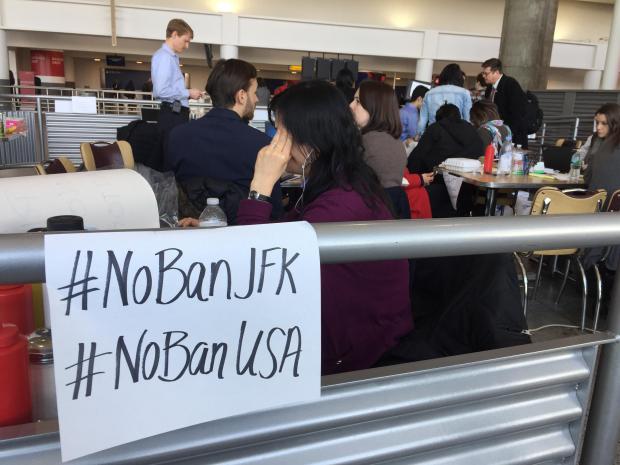
At JFK Airport, Lawyers And Translators Offer Services Pro-Bono

sign

International Business Times | 30 January 2017

It was quiet Monday morning at Terminal 4 at John F. Kennedy Airport in New York City. There was no sign of protesters, and nobody was chanting “Let them in!”

Instead, a group of lawyers and translators is gathered at the Central Diner, a small, red-paneled building sitting in the arrivals gate of the terminal. At about 9 a.m., about 20 volunteers were working. By 2 p.m., upwards of 50 gathered — some wore suits, others vests and hoodies, most of them relatively young. Some sat at tables, drinking coffee donated from Dunkin’ Donuts. Others sat on the floor and typed away on their laptops. For many, heavy bags under their eyes indicated that they’d been awake and working all night.

They had worked all weekend long and into Monday, but they weren’t being paid. These lawyers were part of the on-the-ground effort opposing President Donald Trump’s executive order temporarily banning refugees and people from the Muslim majority countries of Iran, Iraq, Libya, Sudan, Somalia, Syria and Yemen. Trump signed the order Friday. As of Monday, 630 lawyers in New York were signed up to volunteer their time and services at JFK Airport.

“Mobilization was incredible, but it was a bit of a logistical headache,” Camille Mackler, director of legal initiatives at the New York Immigration Coalition, said Monday.

The American Civil Liberties Union, which raised $24 million over the weekend, filed lawsuits at the federal level, and one of those lawsuits halted deportations Saturday night. But it’s the motley crew of volunteer lawyers at the airport who worked pro bono on the ground. They communicated with individuals’ families to file habeas corpus petitions to release travelers who had been detained at airports.

By Monday afternoon, 42 people had been released from airports after being detained. Two other travelers were deported before Saturday’s federal ruling. Two were unaccounted for, with family members concerned that they had been detained, although that hadn’t been verified. And Monday afternoon, the legal group received reports that at least nine people, including one child, who flew in from Saudi Arabia were held for multiple hours at JFK, although the nationality of the travelers who were detained for questioning was unclear.

It’s difficult to verify this information, Mackler said, because the Department of Homeland Security and the U.S. Customs and Border Protection were not communicating with the lawyers.

Lawyers arrived Saturday, an unprompted effort with the goal of freeing travelers who had been detained at the airport for several hours. More and more attorneys joined throughout the day, including those from the New York Immigration Coalition, and their outpost turned into an organized system. They’ve stayed in Terminal 4 ever since, trading shifts so they could sleep and shower.

When volunteer lawyers arrived at the Central Diner, they were assigned to work with a group, each handling a different task: tracking flights of travelers; corresponding with family members; translating; and promoting the group on Reddit and Twitter. Some attorneys were dispatched to help any traveler who might need help when landing.

“It’s a matter of triage to see who needs help,” said Sara Lind, an attorney who’s now in graduate school at Columbia University in New York City.

The number of detainees has been decreasing since the attorneys arrived at JFK Airport, but now the legal group is grappling with other challenges. For one, there’s the issue of people being rejected from flights at foreign airports. Although Homeland Security Secretary John Kelly said green card holders would be allowed into the United States, travelers do not receive their green card until landing in the U.S. People set to board planes in foreign countries with green card paperwork have been turned away because they did not have the green card itself, said Mackler.

In addition, the New York Immigration Coalition received reports that some people were stopped from boarding planes by having their visas blocked. Travelers with visas are allowed to enter the U.S. on a case-by-case basis. The group of lawyers at JFK was working with the Urban Justice Center, a non-profit legal advocacy group, to communicate with people who are being turned away abroad.

What’s more, two of the travelers who were detained and then released were from Saudi Arabia and Senegal — two countries not affected by the ban. It’s possible that these travelers were refugees and therefore affected by Trump’s executive order, Mackler said. But the uncertainty surrounding why they were detained has raised questions about how the ban is being implemented, and whether other countries are next on the ban list.

“We’re still here, and we’re going to keep being here for the foreseeable future,” Mackler said.

This Writer Plans To Stop The White House By Publishing Lies

paul-horner-cnn

International Business Times | 22 January 2017

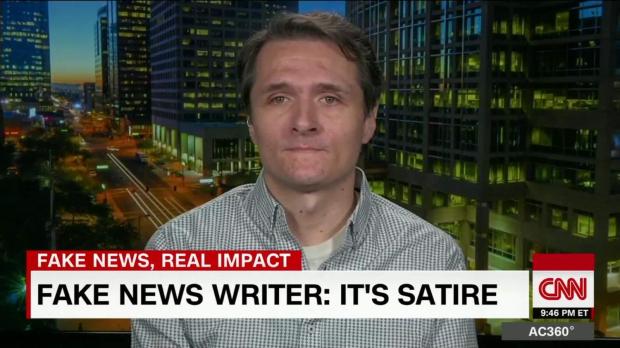
Paul Horner, the man known for his sham articles that spread across the internet, has published his latest story: “Twitter Deletes Donald Trump’s Twitter Account: ‘We Will Not Tolerate Racism and Hate.’”

The site cnn.com.de also features articles about President Barack Obama banning the national anthem and declaring September National Muslim Appreciation Month. These reports, like all of the stories written and published by Horner, a 38-year-old writer of satire and fake news, are bogus. Twitter is not deleting President Donald Trump’s account. Obama has not banned the national anthem. There isn’t a federally mandated month dedicated to Muslims. And the website that hosts these stories, cnn.com.de, is not affiliated with CNN.

Amid a national conversation about fake news and how such stories influence public opinion, Horner became famous online after Election Day for claiming his fabricated reports helped turn voters against Democrat Hillary Clinton. With the former business mogul now in power, Horner wants to use fake news — or “shenanigans,” the term he prefers — to take down the president. He’s convinced that his writing has a purpose: to use false information to give people the truth.

Interest in fake news rose dramatically around the time of the U.S. presidential election, when the campaign between Trump and his equally unpopular rival, Hillary Clinton, saw fabricated stories mushroom on social media. Google searches spiked from the last week of October to the second week of November. Since then, the term “fake news” has been regurgitated and debated by lawmakers, academics, journalists and other Americans.

Horner told the Washington Post in November he was afraid his stories helped put Trump into the White House, and his notoriety was exacerbated when he said Trump supporters were naïve.

Horner began receiving hate messages calling him scum after the interview. He stepped back from publishing his fake news stories, keeping a low-key profile on his hoax news sites for the next month. In January, he began writing once more, this time with a new approach.

His story about Twitter deleting Trump’s account is filled with fabricated quotes. The journalist who supposedly wrote the story — Jimmy Rustling, who has Pulitzers, a mail-order bride and an adopted Syrian daughter, according to his online biography — does not exist. It’s the pseudonym Horner uses for his fake CNN site.

Horner’s story leans heavily on hyperpartisan anti-Trump rhetoric. Trump, according to the story, appointed a climate change denier as head of the Environmental Protection Agency (perhaps skeptic is a more accurate term, as Scott Pruitt has admitted that the climate is changing, although he said the extent to which human activity causes that change is debatable) and a person who “doesn’t believe in public education” in charge of the Education Department (Betsy DeVos has criticized the way public education operates, but she hasn’t said she wants to do away with the system entirely).

Yet throughout the piece, Horner also references and links to several stories from reputable media outlets such as The New York Times, Time Magazine and Vanity Fair. This tactic is markedly different from many of his previous political hoax news pieces, which were mainly crafted from his imagination.

The goal is to lure people in with a false, clickbait title — “Twitter Deletes Trump’s Twitter Account” has gotten over a million views, Horner said — and then offer them persuasive facts in the story.

“It gets that person that’s a follower of TMZ — people that don’t follow anything political or know anything really that’s going on, they just know Donald Trump is our next president… it gets the person who will read that story (to) pretty much (be) forced to learn about everything that’s negative about Trump,” Horner said.

If the comments on the story are any indication, however, not everyone is getting the message.

“Cnn and the rest of the liberal media are just scared Trump can communicate directly with the American peole and does not need the media or that they cant control the narrative. They are trying to silence his 1st amendment the most un-american thing they can do,” one visitor to the site wrote.

Horner, who lives in Phoenix, is used to juggling multiple tasks at once. He spoke with IBT over the phone while heading to a Safeway grocery store in an Uber. After the driver seemed to become confused with directions and took a few wrong turns, Horner canceled the ride and left the car.

“Oh my god, what was wrong with that f*cking guy?” he said. And then: “Sorry about that … I’m walking back to my apartment right now. Let’s do this again.”

Writing hoax stories may be lucrative — $10,000 a month through Google’s AdSense program, he said — but it’s not all he does. He also deals in online day trading. He tries his hand at stand-up comedy. He writes for his online journal. And he runs the charity Sock It Forward, which he plugs in many of his fake news stories.

Horner takes pride in his work, differentiating himself from “crap” fake news sites, he said.

“I could write a story right now about Paul McCartney from The Beatles dying, and it would go viral, and it would make $10,000 in ad revenue,” Horner said. “But there’s no purpose, it’s morally wrong. That’s why I don’t do it.”

It’s that same moral code that guided Horner when he published a story called “The Amish In America Commit Their Vote To Donald Trump; Mathematically Guaranteeing Him A Presidential Victory” in October.

“The purpose of the story was to try to get Trump supporters not to go out and vote, thinking that they didn’t have to vote now because the Amish had locked up the vote,” Horner said. After the election, he “started thinking maybe that story helped him get elected.”

But some of his articles seem to have no purpose at all. Another one of his recent stories carried this headline: “Police Officer On LSD Attempts To Save Anti-Masturbation Dolphin Mascot From Imaginary Fire.”

The fact is, fake news has been around for at least hundreds of years. In the 15th century, a priest in Italy spread rumors that Jews murdered a Christian toddler, drained his blood and drank it to celebrate Passover. And then there’s the Spanish-American War. Just over 100 years ago, the U.S. found itself in a military conflict thanks to two news empires driven by sensationalism.

Media critics today debate about what falls under the umbrella of fake news. Is it total fabrication to get clicks and money? Conspiracy theories on message boards? What about reports with questionable information (see BuzzFeed’s Golden Showers scoop), or selecting certain facts in news stories while intentionally ignoring others? Some critics now cry “fake news!” over facts they simply disagree with.

All of that is further complicated by the online infrastructure that directs how falsities are spread, which is often through Facebook and Twitter. Since the “fake news” news exploded in November, Facebook and Google both announced measures to try and curb stories that peddle false information. Google, for instance, has pledged to ban fake news sites from AdSense, its advertising service.

“The most critical way to counter fake news now is (for the press) to be extremely skeptical when confronting Trump,” said Angelo Carusone, president of Media Matters, a non-profit, progressive watchdog group based in Washington, D.C.

Louis Jacobson, senior correspondent for fack-checking site PolitiFact, went even further, arguing that no real progress will come unless other systems are changed.

“We and other fact checkers are working with Facebook to check and label questionable, widely shared posts,” Jacobson said. “I hope this proves valuable, but we’re just starting, so it’s too soon to know. The other solutions to this problem, such as better education of students about critical thinking, are only going to occur over the longer term.”

Horner, for his part, said he supports efforts to curb false information.

“I can tell you that I’m a big fan of Facebook and Google’s attempt at getting rid of the actual fake news that’s out there,” he said.

His stories haven’t been targeted by Facebook or Google, he said, and he isn’t worried about being shut down himself.

Is Horner concerned that his new stories will backfire and build support for the Trump?

“There’s no chance of getting him elected twice,” he said.