Why was Bluffton’s police chief paid nearly $80,000 to not be in Bluffton?

Island Packet | June 23, 2017

Bluffton police chief Joey Reynolds traveled out of town for almost five of the past 15 months, including to places like Argentina, Chile and Morocco, in his separate role as a board member of an international police organization — mostly while receiving his regular taxpayer-funded salary.

His overall travel time connected to his involvement with the FBI National Academy Associates was almost 10 months, or about 17 percent, of his nearly five-year tenure as chief, records show.

The estimated cost to Bluffton taxpayers while he was absent: $78,738, which represents the amount of town salary he was paid while he was traveling on FBI NAA business.

In addition, when the 60-year-old Reynolds, whose annual salary this year is $118,059, retires on June 30, he will be eligible for a cash payout of as much as $41,911 for his unused paid time off — money that could have been used to help offset the taxpayer cost of his travels.

Since becoming Bluffton’s chief in September 2012, Reynolds has taken 67 trips with the FBI NAA, an alumni association for the nonprofit FBI National Academy, a training organization near Washington, D.C. The FBI NAA bills itself as the “world’s strongest law enforcement leadership network,” boasting a global membership of nearly 17,000.

Reynolds, who has been involved with the Quantico, Va.-based organization since 1996, is completing his one-year term as the FBI NAA president. He was scheduled to spend parts of the weeks of June 12 and June 19 in Cambodia — his last NAA trip while the Bluffton chief.

“I’ve never heard of it before — not to this magnitude,” said John Crangle, a longtime government watchdog and government relations director for the South Carolina Progressive Network, a Columbia-based advocacy organization aimed, according to its Facebook page, at promoting “good government and healthy communities.”

“Sometimes state or local employees go off on business, go to a professional conference or something like that,” Crangle, an attorney, continued. “But here you have an unusually high number of absences to the point where it’s going to interfere with the police chief’s performance of his duties.

“How can you perform your duties when you’re gone so much from the workplace?”

Reynolds and town officials said his absences didn’t interfere with his duties as chief; all his travel expenses were paid by the FBI NAA; and the police department directly benefited from his NAA board positions.

“I’m so proud of our capabilities now,” Reynolds said in an interview earlier this month at the police department. “When I first came, I was worried when we got a major incident. Now, there’s nothing we can’t handle.”

Reynolds, town officials and members of the town council all contend the benefits of the chief’s involvement with the FBI NAA — including training opportunities and connections with other police departments — justified the cost to taxpayers.

In addition, Reynolds said his acceptance of the chief’s job was conditional in part on the town allowing him to continue his involvement, which included out-of-town travels, with the NAA.

But although his 2012 employment-offer letter acknowledged that his FBI NAA role “may cause time away from Bluffton,” it didn’t put any limits on the number of those trips. It also was silent about whether the town would pay his regular salary or require him to use his paid time off while he was gone.

A review by The Island Packet and The Beaufort Gazette of police and town records obtained under the S.C. Freedom of Information Act found that:

▪ Since Reynolds started as Bluffton’s chief on Sept. 17, 2012, he traveled out of town on FBI NAA business for a collective 290 days, 200 of which, or about 70 percent, were during weekdays — totaling 40 normal work weeks — and 90 days were on weekends.

▪ Of his 67 trips, 60 were to various locations throughout the U.S., while seven were to Argentina, Austria, Cambodia, Chile, Germany, Nepal and Morocco.

▪ When Reynolds traveled for FBI NAA business on weekdays, at least 93 percent of his travel was done when he was being paid his full-time salary.

▪ Although Reynolds accrued about 129 paid-time-off days over five years, he opted for the most part not to use his PTO hours on travel for FBI NAA business. Employees can use their PTO hours for sick days, vacation days and bereavement at their discretion, according to the Bluffton town handbook. In the nearly five years of his employment, he took approximately 36 PTO days as of June 7, according to deputy town manager Scott Marshall.

▪ According to town policy, PTO hours roll over and accrue year-to-year. With the 720 PTO hours, or approximately 92 PTO days Reynolds had left over as of June 7, he is entitled to receive a cash payout of $41,911.20 when he retires June 30. That’s assuming he doesn’t use any more PTO hours from June 7 to June 30.

▪ Since becoming chief, Reynolds’ annual pay increased from $98,900 to $118,059, a jump of more than 19 percent. In comparison, the average annual salary for police chiefs in the U.S. is $88,400. And the average salary for S.C. police chiefs is $59,240 — about half as much as Reynolds’ salary — according to May 2016 data from the U.S. Bureau of Labor Statistics. Reynolds leads a department of 51 sworn officers and 12 non-sworn officers.

As Reynolds rose through the ranks on the FBI NAA Board of Executives over the past five years, his travel increased, too, records show. In 106 days as chief in 2012, he traveled six days; in 2013, he spent 26 days traveling.

But in 2016, the year he became the board president, Reynolds was gone 99 days total, including 76 weekdays. That’s about 15 five-day weeks — or nearly four work months out of the year.

It’s not required that the FBI NAA president be an active law enforcement officer, though it is required for some lower board positions, according to Steve Tidwell, the organization’s executive director. The NAA does not pay Reynolds a salary, although it does cover his travel costs, he said.

Bluffton town officials on May 31 announced that Reynolds, who spent most of his law enforcement career in North Carolina, was retiring from the department at the end of this month.

The announcement came amid open-records requests by the Packet and Gazette newspapers for documents relating to Reynolds’ travels with the FBI NAA. Police department spokeswoman Joy Nelson said recently the chief’s decision had “absolutely nothing” to do with the newspapers’ investigation.

In his interview earlier this month, Reynolds said he chose this time to leave to be closer to his family in North Carolina. He also said he found an “opportunity” in the private sector in North Carolina, though he declined to give specifics.

TOWN AWARENESS

Bluffton officials say they knew of Reynolds’ involvement with the FBI NAA when he was hired, and that he would travel in his outside role.

Reynolds’ direct supervisor is the town manager, a position held by Anthony Barrett when the chief was hired in September 2012. In an email this month to the newspapers, Barrett said he knew that Reynolds would be required to travel for the FBI NAA, noting Reynolds’ involvement with the organization was partly why he was chosen to lead Bluffton’s police department.

The town’s offer letter to Reynolds, dated Aug. 20, 2012, reads:

“…(T)he town understands and values your membership with the FBI National Academy Associates and acknowledges your executive Board participation and your rise in 2017 to its presidency which may cause time away from Bluffton.”

Although the offer letter acknowledged Reynolds’ potential travel, it did not include specifics regarding how much time Reynolds would be away from Bluffton, which is significant, according to Crangle of the S.C. Progressive Network.

“Why were the terms so vague about these absences?” Crangle said. “Why wasn’t there any specificity as to how many absences would be authorized, and whether or not he would be paid when he was absent?”

Asked whether Reynolds discussed the extent of his travel with Barrett when hired, Barrett replied: “Of course he did. Do you believe a consummate law enforcement professional and highly ethical person as he is would do otherwise?”

Barrett, who is now executive director of the Bluffton Historical Preservation Society, declined to answer further questions about Reynolds’ employment terms, though he praised the chief as one of his “finest appointments.”

Besides his current annual $118,059 salary, Reynolds receives other benefits, including a $600 monthly car allowance, $76 monthly internet reimbursement, and a bonus this year of $862, according to an email from Marshall, the deputy town manager.

Marc Orlando, Bluffton’s current town manager, told the newspapers he was aware of the extent to which Reynolds would be traveling, because he was connected to Reynolds’ online calendar. And he approved Reynolds’ trips, contending that his FBI NAA presidency “pays dividends” to the police department and the town.

“Chief Reynolds has done an amazing job as our chief of police and a leader in our community over the past five years,” Orlando said. “I believe that his police officers have benefited from his vision, his global understanding of policing, and the practices that he has put in place, including special investigations teams, a community policing platform and high-quality training for everybody in the police department.”

Orlando and Bluffton Mayor Lisa Sulka traveled with Reynolds to an FBI NAA conference in St. Louis in July 2016 — a trip that was paid for by the town of Bluffton — when Reynolds became president of the organization. Sulka helped swear him in.

“When he was vice president, I do remember the discussion of the length that he would be gone — not to the number of days — but the town was very aware of it,” said Sulka in a recent interview. “We were not surprised.”

Sulka added she expected Reynolds’ travel to take him away from the town more than it actually did.

Other current Town Council members contacted by the newspapers said while they were not aware of the exact number of days that Reynolds traveled, they were notified when Reynolds would be gone.

BENEFITS FOR BLUFFTON?

The question that follows: Did the town get its worth for what it invested in Reynolds and his FBI NAA involvement?

Reynolds says yes.

Part of that value, he said, comes in the form of training.

“Two Bluffton police officers have been sent to the FBI National Academy at very little cost to the town,” Reynolds said. “I mean, if I had to pay per diem for somebody to go to that academy for ten weeks, I couldn’t afford it.”

The academy offers its 10-week training sessions to police officers free of charge, said Kurt Crawford, a media representative for the FBI’s training division. Local police departments are required to pay the officers’ salaries while they are at the training, and they may opt to pay for transportation as well, he said.

Reynolds said he also used his clout in the FBI NAA to enable the Bluffton Police Department to host training sessions without the cost of paying for the instructor — 52 sessions last year — and town police officers were allowed to participate.

In addition, Reynolds said he made connections with other police departments, both nationally and internationally, through the NAA. He said that has allowed him to communicate with other police chiefs about best practices for various challenges, such as handling Hurricane Matthew last fall or developing a K-9 unit.

For instance, after Hurricane Matthew hit the Lowcountry, Reynolds said he utilized the FBI NAA’s partnership with the Christian humanitarian organization Samaritan’s Purse, which helped community members with post-hurricane cleanup for two months.

Reynolds said his connections could help with investigations that span across state and even national lines.

“If I’ve got a bad guy that’s in Michigan, I’ve got a contact in Michigan that we can call… (and we can) work together,” Reynolds said.

Another major plus was spreading the word about Bluffton, Reynolds and others said.

“Just because the chief wasn’t here in his community, he was still representing Bluffton and basically exposing Bluffton to so many people who had never heard about the town on a national and international level,” said Nelson, the Bluffton police spokeswoman.

Experts contacted by the newspapers were divided about the benefits and drawbacks of having a police chief so deeply involved in a professional organization.

Reynolds’ association with the FBI NAA can help put “your department, your city on the map. It’s a very well-respected organization,” said Adam Dobrin, associate professor of criminology at Florida Atlantic University.

“It’s not uncommon for a police chief to be involved in professional organizations,” said Stan Stojkovic, professor of criminal justice and dean of the Helen Bader School of Social Welfare at the University of Wisconsin-Milwaukee.

But he added: “We don’t expect them (police chiefs) to be gone for long periods of time. People who are citizens have an expectation of your presence. Your presence provides the face of legitimacy.”

PUNCHING THE TIME CLOCK

Bluffton town payroll records obtained by the newspapers show that Reynolds’ paycheck is calculated on a 39-hour work week. But the chief said he routinely puts in far more hours.

“If you want to talk about time, I work weekends; I work nights,” Reynolds said. “I don’t work a 39-hour week. I never have, and I’ve been involved in law enforcement for 40 years.”

“The chief of police is on duty 24/7,” said Arthur Baylor, who served as president of the FBI NAA in 2009 while serving as the police chief in Montgomery, Alabama.

Still, although Reynolds is a salaried employee of the town, he has received overtime pay – which, under town policy, he is eligible to receive only for emergency situations – most notably last Oct. 20 when he received $16,216 for 195 hours of overtime, payroll records show. Town officials said that pay covered the time when Reynolds worked during Hurricane Matthew.

In recent years, Maj. Joseph Manning, the town’s deputy chief who was hired in September 2013, often was named acting chief when Reynolds was away on FBI NAA business, according to memos from Reynolds to department staff. On June 7 – a week after town officials confirmed Reynolds’ planned retirement to the newspapers – town manager Orlando announced that he had hired Manning as Reynolds’ permanent replacement, effective July 1.

Reynolds said even when he was out of town on FBI NAA trips, he was in regular communication with the police department. While away, he said he checked in with Manning at least twice a day, plus answered emails, phone calls and text messages regarding department business throughout the day.

“I made calls to (Reynolds) when he was away, and he still answered the phone,” said town council member Larry Toomer – a sentiment echoed by Sulka and other council members. “He was always available, even when he was out of town.”

PTO PAYOUT

Even so, though, Reynolds’ time spent traveling with the FBI NAA far exceeded the one or two weeks a year that other professionals or public officials might typically spend at conferences.

And because he usually was paid his regular town salary during his travels instead of using his PTO hours, he is entitled to receive a cash payout for accrued PTO hours when he retires, Orlando said.

The newspapers’ calculation puts that figure at $41,911, assuming Reynolds doesn’t use any more PTO before he leaves at the end of next week.

“It’s important that he has the same rights and privileges and allowances that every other employee has that has worked for the town of Bluffton,” Orlando said, referring to the PTO payout.

Reynolds justified receiving his regular town salary during his travels with the FBI NAA, contending it was “standard” practice.

But “there’s no clear answer” when it comes to whether public officials should receive their regular salary or PTO when traveling for a professional organization, said Gene Brewer, a University of Georgia professor who specializes in human resources issues in public administration.

“It depends partly on how closely that secondary duty is related to the primary duty,” Brewer said.

In other words, whether Reynolds should have been paid his regular town salary for working with the FBI NAA depends on how much work he did related to Bluffton’s police department while traveling — a figure that’s difficult to quantify.

Diane Scanga, director of public safety programs at Jefferson College in Missouri and who was president of the FBI NAA in 2012, said her time traveling for the organization was split between PTO and regular paid time. She said she took nine trips related to the NAA, along with a few other trips to police conferences, during her presidency; in comparison, Reynolds took 26 trips during his presidency, records show.

But Scanga said the role of the NAA president is tied up with the role of police chief.

“There’s the value of what contacts he’s making, and value in what information he’s getting,” she said.

Barrett, who hired Reynolds; Orlando; and current and former Town Council members contacted by the newspapers shared Scanga’s view, offering both approval and praise of the police chief.

For his part, in the final days of his tenure, Reynolds stands by his decision to work for the police department and the FBI NAA at the same time.

“I’m proud of what we’ve done here in this community,” he said.

The History of IRE

Investigative Reporters and Editors | 2015

Chapter 1 – Desert Rats
Phoenix, Arizona – June 1976

Reporter Don Bolles was invited to speak on a panel at the first IRE Conference in Indianapolis.

Bolles was an investigative reporter, the lone-wolf type, the kind who would attach a piece of Scotch tape to the hood of his blue Datsun to make sure that nobody had tampered with his engine.

By 1976, he’d left the investigative beat and become a state capitol reporter. Fellow reporters at The Arizona Republic noticed that his days were less stressful and his drinking less intense.

But Bolles’ investigative itch never quite subsided. When he received a telephone call from a man named John Adamson who claimed to have a tip connecting Arizona Sen. Barry Goldwater and prominent state GOP figure Harry Rosenzweig to mafia-associated land fraud, Bolles agreed to meet.

“John Adamson … Lobby at 11:25 … Clarendon House … 4th and Clarendon,” Bolles wrote in his office calendar.

On June 2, Bolles walked into the Clarendon House lobby. After he waited for 15 minutes, Adamson called to say the source fell through. Bolles headed back to his car.

When he entered his car, a bomb planted underneath detonated.

Bolles lasted 11 days in the hospital before he passed away. He died days before the first IRE Conference.

Indianapolis – 1976

In the late ’60s and early ’70s, reporters in different cities had been scrutinizing illegality and corruption. IRE was the brainchild of a group of journalists that gathered in Indianapolis.

“There was a lot of ferment going on at the time, a lot of people becoming aware of investigative reporting,” said Jim Steele, an IRE member since the beginning. “A lot of people pin it to Watergate, but the impetus really came from the Vietnam War and the critical journalism that came up in the coverage of the war.”

In February 1975, that nationwide effervescence of investigative reporting was condensed into IRE during an organizational meeting in Reston, Virginia.

“It was exciting, it was fun, it was interesting,” Myrta Pulliam, IRE cofounder, said of the Reston meeting. “Everybody had their own idea of what that is, and we had to mush all of that into something that would work.”

Investigative reporters often felt the unhealthy side effects of their craft — being isolated from other journalists and hovering above the line between diligent and paranoid. IRE was an effort to pool together resources from investigative reporters across the country and create a network of information and collaboration.

The first conference in 1976 drew more than 200 journalists eager to share tips, strategies and drinks.

“There was tremendous excitement about the possibilities at that first meeting,” Steele said.

But even with the simmering excitement that accompanies the beginning of a movement, a dark undercurrent shaded conversations in hallways between panels and lectures.

Bolles’ absence had a palpable presence in that Indianapolis hotel. A fake tip and a car bomb — that could have been any conference attendee’s fate.

After a growing number of conversations about their Arizona colleague, the IRE journalists made an unprecedented decision. They would go to Phoenix and finish Bolles’ reporting.

The reporters didn’t descend upon Phoenix to solve Bolles’ murder. Rather, they went to prove a point and buy an investigative reporting insurance policy: You can’t kill a story by killing a reporter.

To read the rest of the story, visit the IRE website.

In the battered news industry, are nonprofits best equipped to survive?

Digital Content Next | Kasia Kovacs

Over the past decade, the nonprofit news model has offered some hope while traditional news outlets struggled to keep afloat. Without the need to rely on advertisers and instead making money through fundraising and memberships, nonprofit news outlets have proliferated.

But recently, that hope has flickered. The worldwide Covid-19 pandemic, or coronavirus, triggered a tsunami to batter an already troubled industry. With advertisers losing money and pulling ads from news outlets, media companies are furloughing and laying off workers. And, in some cases, publications are being shut down temporarily or entirely.

How will nonprofit news outlets fare in the face of this pandemic and the economic downturn that follows? Perhaps better than traditional news outlets. New York Times columnist Ben Smith went so far as to advocate letting the for-profit model fail while supporting nonprofits instead. However, even with booming readership and engagement, nonprofits are concerned about how an economic recession will affect donations and fundraising, and ultimately, their future.

The promise of nonprofit news

Traditional news outlets began wrestling with declining revenues long before coronavirus spread throughout the world this winter. Although digital traffic has either increased or leveled off, advertising revenue continues to fall. Pew Research Center’s most recent State of the News Media Report found that ad revenue dropped by 13% from 2017 to 2018, continuing a trend that began in the early 2000s.

Further, the number of newsroom employees in the newspaper sector was essentially cut in half from 2006 to 2018. The number of newsroom jobs dropped by 36,510, according to the Pew report.

But nonprofit news organizations sketched a different picture of the future, offering the news industry a sense of hope. “It may be one way to start to repair the loss of trust in and public engagement with journalism in North America,” wrote University of British Columbia associate professors Alfred Hermida and Mary Lynn Young in Nieman’s predictions for journalism in 2020.

Journalism philanthropy quadrupled over the past decade, according to a 2019 Media Impact Founders report. Today, more than 230 nonprofit media organizations are members of Institute for Nonprofit News (INN), an organization that began with 27 members in 2009. Over two-thirds of INN’s members have launched in the past 12 years. INN’s members also employ about 3,000 staff, including 2,000 journalists, according to the organization’s 2019 Index.

Nonprofit strategies

These nonprofit outlets have provided necessary and often resource-heavy journalism that newspapers with dwindling funds might struggle to take on, especially watchdog and investigative reporting. Many nonprofit organizations cater to local audiences or report on niche topics, such as gun control, the environment, or education.

Certainly, many nonprofit news outlets earn some revenue from advertising and corporate sponsorships. However, these organizations rely most heavily on memberships and donations from individuals, families, and foundations. In the past, foundations provided the majority of the funding for nonprofits. However, the 2019 INN Index found that individuals and families contribute now about 40% of nonprofit funding. That same year, foundation funding dropped below 50% for the first time.

Even some for-profit news organizations have integrated strategies from the nonprofit model. The Guardian made an operating profit in 2019 for the first time in two decades after pulling off a financial turnaround strategy. This was, in large part, thanks to donations from more than one million readers.

And, faced with furloughs and possible layoffs, Vox Media is trying its hand at soliciting support from its audience. Emphasizing its wish to eschew the subscription model and keep its journalism freely accessible, particularly at this time, the company is turning to readers for support.

Of course, nonprofit outlets have not been the deus ex machina to single-handedly save the news industry. Journalism scholars have pointed out the shortcomings of a nonprofit business model. These include the risk of catering to elite donors rather than publishing stories for a wider audience. Larger nonprofits also tend to fare better than smaller organizations, which may struggle to raise enough funding.

Enter the pandemic

When coronavirus spread — first to Asia, then Europe, and then the U.S. — it dealt a serious shock to the news industry. Digital traffic to news websites increased significantly, with anxious visitors reading about the growing number of coronavirus cases, troubles with virus testing, and best practices for health and safety.

Despite this boost in page views, advertisers faced with their own losses have hit the brakes on many ad campaigns. They’ve also intentionally reduced the number of ads on digital news websites due to concerns about appearing next to coronavirus news. Buzzfeed News found that advertisers stopped over two million ads from showing up on news sites in the first three weeks of March.

As a result, Gannett is furloughing journalists at local newspapers across the country. Euclid Media Group announced layoffs at its seven publications. Some alt weeklies have shuttered entirely. And with economists predicting a global recession, the long-lasting repercussions of the pandemic look dire.

Traffic climbs

Nonprofits have faced consequences too, although they haven’t been so catastrophic.

High Country News — an independent magazine based in Colorado has maintained its nonprofit status for decades. Like many other news sites, it has seen a considerable increase in online readership of late.

Although the magazine normally publishes articles on issues relating to the western U.S., HCN assigned a team of about 10 journalists to focus on COVID-19. Stories shared details about the dangers of self-isolating on public lands, how to ethically get outdoors, and how rural doctors face the virus.

“Every story that we’re putting out on COVID-19 has just blown up. There just seems to be a huge appetite for those stories,” said Paige Blank, associate editor at HCN who is now leading the coronavirus coverage at the organization.

The number of users in March rose about 48% compared to the same time last year, and the number of new users also increased by nearly 53%. Plus, visitors are not just reading stories, but also becoming more engaged.

“The tip form has been getting a ton of responses from our readers,” Blank said. “We’re actually able to gauge what people are worried about right now. And we’re using those tips to tailor our coverage for our readers.”

But will revenue follow?

But whether that traffic and engagement can translate to sustainable revenue is unclear. So far, HCN hasn’t seen an uptick in donations in March. The magazine hopes to harness the traffic by launching an online fundraising campaign in late April, said Laurie Milford, development director at HCN.

Still, the magazine delayed a 50th anniversary campaign which it expected to raise $10 million this year. (The campaign gala is now scheduled for June 2021.) Overall, HCN expects to see a 25% reduction in general fund receipts in 2020.

HCN’s predicament is pretty representative of what most nonprofit organizations will be grappling with in the coming months, according to Sue Cross, INN executive director and CEO.

“It’s a mixed picture, she says. However, the situation “appears quite a bit better than the situation for for-profits,” Cross said. “(I’m) hearing of really significant increases in individual donor support. But some others that had a lot of events/sponsorship revenue or advertising income are hurting… For most, their community position and funding are up now, but uncertainty remains about future grant funding.”

Not all bad news

When it comes to for-profit news outlets like the Guardian, which also largely rely on reader donations, reader contributions could potentially act as a sort of cushion, softening the pandemic’s severe financial blow. However, thus far, it’s unclear how much of a difference reader donations will make.

In March, the Guardian received about  2.17 billion page views, far bypassing its previous record of 750 million pageviews last October. And the increased traffic appears to be increasing financial support from its online readers, according to editor-in-chief Katharine Viner. However, mid-March the Guardian announced a projected a loss of £20 million over the next six months from declining advertising and newspaper sales, which has led to furloughs and pay cuts.

Indeed, many news organizations hope that readers will see the value of their coverage during the coronavirus crisis and, despite the economic uncertainty, donate. Case in point: Chalkbeat, a nonprofit that focuses on education news in cities like Chicago and Detroit, gained $1,700 in just one week after an appeal for financial contributions.

Chalkbeat has focused its reporting over the past month on how schools are dealing with the pandemic. Traffic tripled in March, according to figures from editor-in-chief Bene Cipolla. Like at HCN, Chalkbeat readers have been involved in spurring content; by the end of March, Chalkbeat had published 20 stories based on the responses to callouts asking for reader questions.

Instead of running its annual spring campaign, the organization is treating the COVID-19 crisis as a campaign unto itself. This means sending out weekly appeals, which resulted in significant donations and 21 new members after one week, according to Kary Perez, senior marketing manager.

Community engagement

In addition, “we have also been approached by lots of people asking us to come to their communities,” said CRO Maria Archangelo. “When they see the kinds of information that we are able to deliver to Detroit and Memphis, they realize what their communities are lacking.”

The future is less certain when it comes to Chalkbeat’s philanthropy partners and major donors, who are dealing with the pandemic consequences on their own terms. Archangelo hopes that donors and funders will realize the importance of Chalkbeat’s coverage once the pandemic has passed, and will continue to provide funding.

For Chalkbeat, HCN, and all other nonprofit news organizations, it’s difficult to calibrate the full impact of COVID-19. But for now, compared to the rest of the news industry, nonprofits seemed to have maintained a level of resilience in the wake of coronavirus’ brutal blow.

In the wake of several big name failures, the industry seeks a solid Spanish language news model

Digital Content Next | 30 January 2020

2019 will be remembered as a turbulent year for Spanish-language news in the U.S. The New York TimesBuzzFeed News, the Huffington Post, and the Chicago Tribune all shut down their Spanish-language websites in a large blow to parts of the 59 million Spanish language speakers in the U.S.

However, as the old decade folded into the new year, national news outlets confirmed that they weren’t giving up on Spanish-language news. In the past two months, The Washington Post launched its first Spanish-language news podcast, El Washington Post, and USA Today started Hecho en USA, its series on Latino communities. As the new decade begins, the future of Spanish-language news in the U.S. remains a puzzle, difficult to piece together.

Revenue review

The reason for the failures of 2019 largely boil down to money. The Times, for instance, initially launched NYT en Español in early 2016 as a way to grow its international audience. This was part of an optimistic goal to generate $800 million in digital revenue by 2020. At the time, Donald Trump’s racist rhetoric was in full force. So, putting the Times’ journalism stamp on important issues south of the border was meant to be a significant step towards the outlet’s lofty aims.

The plan was to support NYT en Español with advertising revenue, along with the hope of turning readers into subscribers. But a little more than three years later, NYT en Español closed its Mexico City bureau. Despite a potential audience of 80 million people, the advertising dollars weren’t coming in, a Times spokesperson said when the website shut down in September. Nor were these readers subscribing. But according to NYT en Español’s founding editorial director Eli Lopez, the Times lacked a credible plan to monetize his team’s content.

In the wake of these ill-fated efforts, Spanish-speaking communities pay the price. More than 8,000 English-speaking news organizations currently serve approximately 250 million English speakers in the U.S. However, for the almost 59 million Spanish speakers – 10 million of whom don’t speak English well – only approximately 624 news outlets serve them.

When Tribune Publishing shut down Hoy Media, their Spanish-language newspaper in Chicago, in November, reporter Laura Rodríguez lamented the news that would no longer be reported for Chicago’s Latino and Hispanic communities.

Markets in need

“I’m seriously so angry and frustrated at the fact that the company decided to get rid of such an important platform for the Spanish-speaking community in Chicago,” Rodríguez tweeted. “I wrote so many stories no one else did — we had our space! Our Latino, Spanish-speaking community counted on us to tell their stories. Those that are often not told.”

While some of the nation’s largest outlets can afford to experiment, the same can’t be said for smaller organizations across the country. Statewide and citywide newsrooms have already faced crushing layoffs and decimated revenues in one of the hardest decades ever for journalism. And Spanish-speaking communities are among those that will suffer the most.

In New Mexico, where slightly more than one million Spanish speakers represent 49% of the state’s population, the Hispanic population is the most underserved. Despite having a long history with the Spanish language that dates back to before the Constitution, the state only has three Spanish-speaking news outlets. And they are all TV stations and all based in Albuquerque. Compare that to neighboring Arizona, home to a Hispanic population around double the size of New Mexico at more than two million. It is home to 17 Spanish-language outlets, more than five times the amount in New Mexico.

Size matters

At a time when local news has already suffered greatly and positive signs are few and far between (it’s estimated that more than 13,000 communities in the U.S. don’t have any local news coverage) is it too much to expect smaller and medium-sized outlets to launch Spanish-language offerings? Given that national outlets such as the New York Times can’t turn a profit from such investments, the answer for many local newsrooms with fewer resources may just be yes. Right now, it is too much.

Scott Brodbeck is just one local news editor who is familiar with the obstacles of running a local news website. Brodbeck is the founder and CEO of Local News Now, a network of hyperlocal news websites he launched in 2010 that serve markets in northern Virginia and Washington, D.C. With the shrinking advertising market for most media companies due to Google and Facebook’s dominance, financial uncertainty is just one reason why local news companies such as Brodbeck’s aren’t able to implement new products specifically for non-English speaking audiences.

“The biggest challenges are recruiting, training and retaining talented people; producing consistently excellent local journalism that attracts a large local audience; and growing sales to keep growing our organization,” Brodbeck said. “Given the challenges of just putting out our current news product, it would be unrealistic to try to do what we’re doing in a second language.”

Demanding demographics

America is undergoing a rapid change in demographic identity. According to Census projections, the Hispanic and Latino population represented just more than 17% of the U.S. population. By 2060, that population is predicted to be roughly 120 million people, or 28 percent. That’s why Brodbeck said that the best solution for local newsrooms in the future could be for them to focus on hiring reporters from diverse backgrounds. That would allow them to serve as many communities as possible.

“Having separate Spanish language brands may make sense for some of the largest news publishers. Smaller newsrooms would be better off putting their energies into developing robust hiring, training, and employee support practices, to cultivate a diverse workforce that can better serve all readers

News outlets continue to wrestle with how to serve diverse audiences. Thus, it might be down to schools and universities to take a proactive approach by preparing the next generation of journalists for the ever-changing media landscape.

One journalism school that’s already doing so is the Craig Newmark Graduate School of Journalism at CUNY. The school’s Spanish-language journalism program aims to train bilingual journalists to better cover issues important to Latino communities. This program could be a footprint for other journalism schools across the country to follow. It could also provide news outlets with a new generation of journalists to serve an increasingly diverse population.

Like many other aspects of an industry grappling with profitability and even survival, the future of Spanish-language news remains uncertain. And just as the industry experiments with reader engagement and revenue models, news organizations and universities are now exploring different methods of delivering Spanish-speaking news, such as podcasts and special series. With so many moving pieces, only one projection is relatively certain: the growing population of Spanish speakers in the U.S.

Missouri towns see another path to prosperity — a bicycle trail along the old Rock Island Line

ROCK ISLAND TRAIL 20150720 (2)
Photo Credit: Shane Keyser

Kansas City Star | 20 July 2015

When Scott Lawson of Windsor, Mo., stepped into his local bank in 2009 and announced that he wanted to buy the Windsor Crossroads Motel, he got the response he expected.

“Are you crazy?” Lawson remembers the loan officer asking.

The Windsor Crossroads Motel was falling apart. It had no televisions much less wireless Internet, and a plumbing system from the 1950s. Residents of the town of 3,000 told visiting family members to avoid the place.

But Lawson insisted.

He bought and renovated the hotel and now has enough patrons that his business is up and running in the black. And he’s expecting far more visitors in anticipation of a new project from the Missouri Department of Natural Resources: the Rock Island Trail.

Lawson is one of many business owners preparing for the state department to finish conversion of the out-of-use Rock Island Railway into a hiking and biking trail. The trail would stretch about 200 miles in Missouri, from Pleasant Hill, a town half an hour southeast of Kansas City, to Beaufort in the south-central part of the state. It also might loop with the Katy Trail, creating 400 miles of the longest rail-converted trail system in the country.

A year ago, the trail’s future was uncertain, but the Surface Transportation Board approved the transfer of the Rock Island corridor from Ameren Corp. to the Missouri Department of Natural Resources in February. Now the greatest challenge is raising funds to build the trail as quickly as possible, said Greg Harris, executive director of Missouri Rock Island Trail Inc., a non-profit coalition of trail supporters.

The Rock Island project has invited comparisons to the Katy Trail, but the two trails are unique. The Katy Trail follows the Missouri River across the state and passes by larger cities such as Columbia.

In contrast, the Rock Island trail is more rural with varied terrain and long tunnels and bridges, including a mile-long bridge 100 feet above the Gasconade River. The Rock Island route also travels through the middle of small towns, which is not as common along the Katy.

FROM RAIL TOWN TO TRAIL TOWN

Business owners along the trail are banking on more visitors, both local recreational trail users and out-of-state tourists.

The Katy Trail, which runs from St. Louis suburbs to Clinton, Mo., has played host to hundreds of thousands of visitors since it was converted from rail to trail 25 years ago. Bed and breakfasts began dotting the route, wineries saw more trail patrons, and bike shops popped up in towns such as Jefferson City and Sedalia.

The Katy Trail attracts about 400,000 visitors who spend $18.5 million each year, according to a 2012 Katy Trail economic impact report, commissioned by the state parks department and conducted by outside agencies. The report estimates that the average group visiting the trail on multi-day trips spends almost $150 each night.

Supporters of the new trail forecast a similar economic boost for towns along the Rock Island corridor.

It only makes sense, they say. The Rock Island Railway brought industry to train towns in mid-Missouri during the 20th century. Thirty years ago, the railway went out of commission, and the towns’ economies slumped. Now, the hope is that the trail will help revive the hard-hit towns.

“Business owners are anxious to see what volume the trail brings in,” said Kim Henderson, Windsor’s city manager.

Indeed, the town’s restaurants have already seen some traffic from the Katy Trail, which passes through Windsor. But Henderson hopes that once the Rock Island Trail is completely built and connected to Kansas City, even more traffic will come from the western part of the state. Business owners in the town have invested, adding a showerhouse and shelterhouse to campgrounds and constructing a few cabins near the Rock Island corridor, Henderson said.

Closer to Kansas City, Pleasant Hill businesses are gearing up for visitors as well. The town has embraced its new identity with a rebranding effort, complete with two new murals decorating its town square.

“Welcome to Pleasant Hill, where the tracks meet the trail,” one mural says.

Alan Voss returned to his hometown of Pleasant Hill after living on the East Coast to open up New Town Bike Shop two years ago.

As the trail is being built, Voss plays the waiting game. He works 60-70 hours a week to keep his bike repair and rental shop and coffeehouse alive, and he’s impatient to see the trail finished and functional.

“Right now, we’re getting by, but we’re not hugely profitable,” Voss said. “But when the trail is built, we plan to expand.”

He’s seen a few curious people stop by, but more progress in construction will mean more avid riders. And that means more bike shops along the trail.

APPREHENSION FROM TRAIL NEIGHBORS

Not everyone is as optimistic.

“We have some doubts about the economic impact of the trail,” said Leslie Holloway of the Missouri Farm Bureau, which campaigned against the trail on behalf of landowners who live nearby.

Trail advocates ignore what the farm bureau sees as possible undesirable consequences of the trail, according to Holloway, such as interference with farming operations on property next to the Rock Island corridor.

Holloway also questioned certain figures in the Katy Trail economic impact report. The survey reports that visitor spending along the trail supports 367 jobs, but Holloway says that figure includes part-time and seasonal workers.

In addition, the Rock Island Trail may not have the draw of the Katy Trail, Holloway said.

“Before we get too far along here, let’s make sure we’re comparing apples to apples,” Holloway said.

Yet Warren Wood, vice president of external affairs and communications for Ameren Corp., the energy company giving the Rock Island Railway to the state, says the differing terrain of the Rock Island Trail will actually be attractive to visitors.

“I’ve driven nearby, and there are areas of (the trail) that will be remarkably beautiful,” Wood said.

Other critics of the project predict that the trail will be a burden on Missouri taxpayers. They wonder how the development and maintenance of the trail will be financed and are concerned about the possibility of higher taxes.

Trails, like any large state project, take money to build. Each mile may cost $5,000 to $50,000 depending on the terrain, said Brent Hugh, executive director of the Missouri Bicycle and Pedestrian Federation. No formal cost estimate has yet been announced.

But Missourians didn’t see higher taxes when the Katy Trail was built. That trail was financed by a mix of public funding, federal grants and private donations, and “I wouldn’t expect this trail to be any different,” Wood said.

Several worries expressed by trail opponents echo concerns brought up while the Katy Trail was built. But now, the state’s residents largely agree that the Katy Trail is an asset to communities. According to the economic impact report, 93 percent of trail patrons are Missourians who rate the trail well overall.

WHEN WILL THE TRAIL BE COMPLETED?

Different parts of the trail are in various stages of development.

Construction on the stretch closest to Kansas City, which extends for 47 miles from Pleasant Hill to Windsor, is underway. Swaths of the trail have already been built, but those stretches are disconnected and 17 miles in total. This section of the trail will be completed next year.

The bulk of the trail runs for 144 miles across mid-to-eastern Missouri. It’s still in the process of being transferred from Ameren, which owns the Rock Island corridor, to the Department of Natural Resources.

Ameren is now conducting an archeological and historical site assessment of the trail, one of the last pieces required by the federal Surface Transportation Board before the salvage process can begin.

Salvaging the corridor, which includes pulling up the steel plates and ties, will be finished in 2019. A timeframe for construction of the trail is unclear, depending on where the state can find funding for it.

In addition, Jackson County has been negotiating with Union Pacific Railroad to buy a corridor that runs from Greenwood to Kansas City, close to Kauffman Stadium. Jackson County hopes to connect this trail to the Rock Island Trail, but there are no promises for the outcome of the negotiations.

Mark Randall, the city administrator of Pleasant Hill and an earnest supporter of the trail, awaits the day when cyclists can ride from Kansas City to St. Louis and stop in his town along the way.

“Even if we have a fraction of the visitors towns get from the Katy Trail, it would make a big impact on our community,” Randall said.

And, if trail advocates are correct, a big impact on the state, too.

What is railbanking?

The Rock Island Trail will be created through railbanking, the process of turning a defunct railroad into a trail. The tracks and ties are pulled up, but the corridor itself is preserved. The trail is considered an “interim trail,” because it could be turned back into a working railroad.

Almost 2,000 tracks have been railbanked in the past 30 years, and only a few have been converted back to a working railroad.

But railbanking has also drawn objection from some landowners who live along the Rock Island corridor.

Property owners granted the railroad company the right-of-way to build over their land through easement. Now some of these landowners argue that, since the railway is out of service, that corridor should return to their ownership. But under the National Trails Act, the corridor is not yet considered abandoned.

At JFK Airport, Lawyers And Translators Offer Services Pro-Bono

sign

International Business Times | 30 January 2017

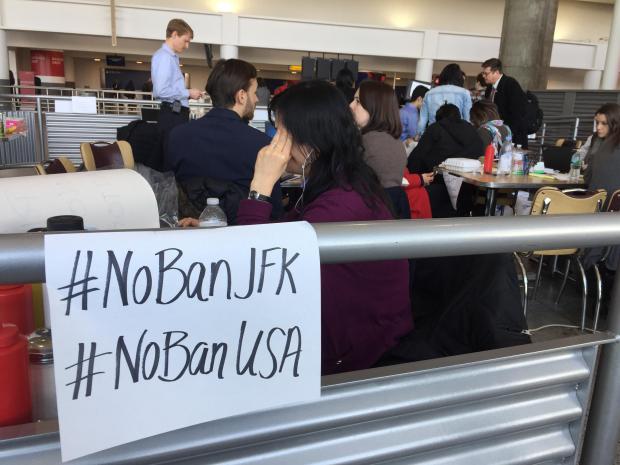
It was quiet Monday morning at Terminal 4 at John F. Kennedy Airport in New York City. There was no sign of protesters, and nobody was chanting “Let them in!”

Instead, a group of lawyers and translators is gathered at the Central Diner, a small, red-paneled building sitting in the arrivals gate of the terminal. At about 9 a.m., about 20 volunteers were working. By 2 p.m., upwards of 50 gathered — some wore suits, others vests and hoodies, most of them relatively young. Some sat at tables, drinking coffee donated from Dunkin’ Donuts. Others sat on the floor and typed away on their laptops. For many, heavy bags under their eyes indicated that they’d been awake and working all night.

They had worked all weekend long and into Monday, but they weren’t being paid. These lawyers were part of the on-the-ground effort opposing President Donald Trump’s executive order temporarily banning refugees and people from the Muslim majority countries of Iran, Iraq, Libya, Sudan, Somalia, Syria and Yemen. Trump signed the order Friday. As of Monday, 630 lawyers in New York were signed up to volunteer their time and services at JFK Airport.

“Mobilization was incredible, but it was a bit of a logistical headache,” Camille Mackler, director of legal initiatives at the New York Immigration Coalition, said Monday.

The American Civil Liberties Union, which raised $24 million over the weekend, filed lawsuits at the federal level, and one of those lawsuits halted deportations Saturday night. But it’s the motley crew of volunteer lawyers at the airport who worked pro bono on the ground. They communicated with individuals’ families to file habeas corpus petitions to release travelers who had been detained at airports.

By Monday afternoon, 42 people had been released from airports after being detained. Two other travelers were deported before Saturday’s federal ruling. Two were unaccounted for, with family members concerned that they had been detained, although that hadn’t been verified. And Monday afternoon, the legal group received reports that at least nine people, including one child, who flew in from Saudi Arabia were held for multiple hours at JFK, although the nationality of the travelers who were detained for questioning was unclear.

It’s difficult to verify this information, Mackler said, because the Department of Homeland Security and the U.S. Customs and Border Protection were not communicating with the lawyers.

Lawyers arrived Saturday, an unprompted effort with the goal of freeing travelers who had been detained at the airport for several hours. More and more attorneys joined throughout the day, including those from the New York Immigration Coalition, and their outpost turned into an organized system. They’ve stayed in Terminal 4 ever since, trading shifts so they could sleep and shower.

When volunteer lawyers arrived at the Central Diner, they were assigned to work with a group, each handling a different task: tracking flights of travelers; corresponding with family members; translating; and promoting the group on Reddit and Twitter. Some attorneys were dispatched to help any traveler who might need help when landing.

“It’s a matter of triage to see who needs help,” said Sara Lind, an attorney who’s now in graduate school at Columbia University in New York City.

The number of detainees has been decreasing since the attorneys arrived at JFK Airport, but now the legal group is grappling with other challenges. For one, there’s the issue of people being rejected from flights at foreign airports. Although Homeland Security Secretary John Kelly said green card holders would be allowed into the United States, travelers do not receive their green card until landing in the U.S. People set to board planes in foreign countries with green card paperwork have been turned away because they did not have the green card itself, said Mackler.

In addition, the New York Immigration Coalition received reports that some people were stopped from boarding planes by having their visas blocked. Travelers with visas are allowed to enter the U.S. on a case-by-case basis. The group of lawyers at JFK was working with the Urban Justice Center, a non-profit legal advocacy group, to communicate with people who are being turned away abroad.

What’s more, two of the travelers who were detained and then released were from Saudi Arabia and Senegal — two countries not affected by the ban. It’s possible that these travelers were refugees and therefore affected by Trump’s executive order, Mackler said. But the uncertainty surrounding why they were detained has raised questions about how the ban is being implemented, and whether other countries are next on the ban list.

“We’re still here, and we’re going to keep being here for the foreseeable future,” Mackler said.

This Writer Plans To Stop The White House By Publishing Lies

paul-horner-cnn

International Business Times | 22 January 2017

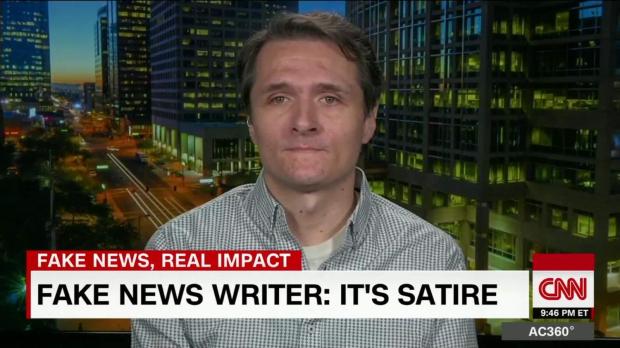
Paul Horner, the man known for his sham articles that spread across the internet, has published his latest story: “Twitter Deletes Donald Trump’s Twitter Account: ‘We Will Not Tolerate Racism and Hate.’”

The site cnn.com.de also features articles about President Barack Obama banning the national anthem and declaring September National Muslim Appreciation Month. These reports, like all of the stories written and published by Horner, a 38-year-old writer of satire and fake news, are bogus. Twitter is not deleting President Donald Trump’s account. Obama has not banned the national anthem. There isn’t a federally mandated month dedicated to Muslims. And the website that hosts these stories, cnn.com.de, is not affiliated with CNN.

Amid a national conversation about fake news and how such stories influence public opinion, Horner became famous online after Election Day for claiming his fabricated reports helped turn voters against Democrat Hillary Clinton. With the former business mogul now in power, Horner wants to use fake news — or “shenanigans,” the term he prefers — to take down the president. He’s convinced that his writing has a purpose: to use false information to give people the truth.

Interest in fake news rose dramatically around the time of the U.S. presidential election, when the campaign between Trump and his equally unpopular rival, Hillary Clinton, saw fabricated stories mushroom on social media. Google searches spiked from the last week of October to the second week of November. Since then, the term “fake news” has been regurgitated and debated by lawmakers, academics, journalists and other Americans.

Horner told the Washington Post in November he was afraid his stories helped put Trump into the White House, and his notoriety was exacerbated when he said Trump supporters were naïve.

Horner began receiving hate messages calling him scum after the interview. He stepped back from publishing his fake news stories, keeping a low-key profile on his hoax news sites for the next month. In January, he began writing once more, this time with a new approach.

His story about Twitter deleting Trump’s account is filled with fabricated quotes. The journalist who supposedly wrote the story — Jimmy Rustling, who has Pulitzers, a mail-order bride and an adopted Syrian daughter, according to his online biography — does not exist. It’s the pseudonym Horner uses for his fake CNN site.

Horner’s story leans heavily on hyperpartisan anti-Trump rhetoric. Trump, according to the story, appointed a climate change denier as head of the Environmental Protection Agency (perhaps skeptic is a more accurate term, as Scott Pruitt has admitted that the climate is changing, although he said the extent to which human activity causes that change is debatable) and a person who “doesn’t believe in public education” in charge of the Education Department (Betsy DeVos has criticized the way public education operates, but she hasn’t said she wants to do away with the system entirely).

Yet throughout the piece, Horner also references and links to several stories from reputable media outlets such as The New York Times, Time Magazine and Vanity Fair. This tactic is markedly different from many of his previous political hoax news pieces, which were mainly crafted from his imagination.

The goal is to lure people in with a false, clickbait title — “Twitter Deletes Trump’s Twitter Account” has gotten over a million views, Horner said — and then offer them persuasive facts in the story.

“It gets that person that’s a follower of TMZ — people that don’t follow anything political or know anything really that’s going on, they just know Donald Trump is our next president… it gets the person who will read that story (to) pretty much (be) forced to learn about everything that’s negative about Trump,” Horner said.

If the comments on the story are any indication, however, not everyone is getting the message.

“Cnn and the rest of the liberal media are just scared Trump can communicate directly with the American peole and does not need the media or that they cant control the narrative. They are trying to silence his 1st amendment the most un-american thing they can do,” one visitor to the site wrote.

Horner, who lives in Phoenix, is used to juggling multiple tasks at once. He spoke with IBT over the phone while heading to a Safeway grocery store in an Uber. After the driver seemed to become confused with directions and took a few wrong turns, Horner canceled the ride and left the car.

“Oh my god, what was wrong with that f*cking guy?” he said. And then: “Sorry about that … I’m walking back to my apartment right now. Let’s do this again.”

Writing hoax stories may be lucrative — $10,000 a month through Google’s AdSense program, he said — but it’s not all he does. He also deals in online day trading. He tries his hand at stand-up comedy. He writes for his online journal. And he runs the charity Sock It Forward, which he plugs in many of his fake news stories.

Horner takes pride in his work, differentiating himself from “crap” fake news sites, he said.

“I could write a story right now about Paul McCartney from The Beatles dying, and it would go viral, and it would make $10,000 in ad revenue,” Horner said. “But there’s no purpose, it’s morally wrong. That’s why I don’t do it.”

It’s that same moral code that guided Horner when he published a story called “The Amish In America Commit Their Vote To Donald Trump; Mathematically Guaranteeing Him A Presidential Victory” in October.

“The purpose of the story was to try to get Trump supporters not to go out and vote, thinking that they didn’t have to vote now because the Amish had locked up the vote,” Horner said. After the election, he “started thinking maybe that story helped him get elected.”

But some of his articles seem to have no purpose at all. Another one of his recent stories carried this headline: “Police Officer On LSD Attempts To Save Anti-Masturbation Dolphin Mascot From Imaginary Fire.”

The fact is, fake news has been around for at least hundreds of years. In the 15th century, a priest in Italy spread rumors that Jews murdered a Christian toddler, drained his blood and drank it to celebrate Passover. And then there’s the Spanish-American War. Just over 100 years ago, the U.S. found itself in a military conflict thanks to two news empires driven by sensationalism.

Media critics today debate about what falls under the umbrella of fake news. Is it total fabrication to get clicks and money? Conspiracy theories on message boards? What about reports with questionable information (see BuzzFeed’s Golden Showers scoop), or selecting certain facts in news stories while intentionally ignoring others? Some critics now cry “fake news!” over facts they simply disagree with.

All of that is further complicated by the online infrastructure that directs how falsities are spread, which is often through Facebook and Twitter. Since the “fake news” news exploded in November, Facebook and Google both announced measures to try and curb stories that peddle false information. Google, for instance, has pledged to ban fake news sites from AdSense, its advertising service.

“The most critical way to counter fake news now is (for the press) to be extremely skeptical when confronting Trump,” said Angelo Carusone, president of Media Matters, a non-profit, progressive watchdog group based in Washington, D.C.

Louis Jacobson, senior correspondent for fack-checking site PolitiFact, went even further, arguing that no real progress will come unless other systems are changed.

“We and other fact checkers are working with Facebook to check and label questionable, widely shared posts,” Jacobson said. “I hope this proves valuable, but we’re just starting, so it’s too soon to know. The other solutions to this problem, such as better education of students about critical thinking, are only going to occur over the longer term.”

Horner, for his part, said he supports efforts to curb false information.

“I can tell you that I’m a big fan of Facebook and Google’s attempt at getting rid of the actual fake news that’s out there,” he said.

His stories haven’t been targeted by Facebook or Google, he said, and he isn’t worried about being shut down himself.

Is Horner concerned that his new stories will backfire and build support for the Trump?

“There’s no chance of getting him elected twice,” he said.

The place where no one has a name

Vox Magazine | 4 May 2016

Missouri’s stretch of Interstate 70 is a lonely one. I often make this drive to get from Columbia to Kansas City and take the time to ruminate on my life. Sometimes, a car passes me, and I look over, curious about whether that driver is also lost in thought about his or her own life: regrets, work deadlines, past loves. Two anonymous lives, strangers confined within our cars, passing by on the interstate.

Tonight, I’m headed somewhere else, a strip club marked by a neon fuchsia XXX sign. From the outside, the building looks like a small warehouse with pink walls. One semi-truck and a few cars are parked in the lot. I walk inside through a small, empty entryway. One door leads to a shop with aisles of porn. Another door opens to the strip club.

Before I walk inside the club, a second door opens. A short man with a ponytail, whom I recognize as the bartender, welcomes me inside. I’ve been here before, identifying myself as a journalist working on a story about I-70. The bartender wouldn’t give me his full name then, and he doesn’t now. He won’t tell me the dancer’s name either. The establishment refuses to reveal true identities. Secrets dwell here.

He recognizes me, too, and informs me that though I am a reporter, I am not welcome to take notes or recordings. The bartender offers me a drink — non-alcoholic, as Missouri strip clubs are banned by law from serving booze.

The dancer is wearing lacy pink underwear, a matching bra and a long necklace that hangs between her breasts. She sways her body, her feet in transparent platform shoes, to Marcy Playground’s 1997 “Sex and Candy” in a dark room lit by dim disco lights.

Five men sit around the stage where she dances. One is a middle-aged man who stares as if he could burn himself into her body, as if she just might secretly know the answers to all of his problems.

The dancer shimmies off her bra, and her breasts are fully exposed. She leans down to the first man and pulls his head to her chest. She giggles, turns to the next man, pulls him from his seat and spanks him.

The men throw bills onto stage. The dancer controls their attention. They control her income.

She slips off her boyshorts, but underneath, she wears a black thong. The same law that bans alcohol also prohibits fully nude dancers.

Six years ago, the state legislature passed a law imposing several restrictions to sexually oriented businesses, including strip clubs. But the law doesn’t just prevent nudity and booze. It also requires strip clubs to close from midnight to 6 a.m., dictates that the stage is six feet from patrons and forbids strippers from touching customers.

Aside from not serving alcohol and closing at midnight, this strip club isn’t a stickler for the rules.

The nudity rule isn’t simple, either. The dancer wears heels, a thong and a necklace. But the Missouri lawdefines nudity as “the showing of … the female breast with less than a fully opaque covering of any part of the nipple or areola.” The dancer’s breasts are fully exposed.

I’ve called state agencies without success to find out how strip clubs are regulated. Representatives from the Missouri State Highway Patrol and state and local divisions of the Missouri Department of Health and Senior Services could not answer my questions. The Missouri Department of Tobacco and Alcohol Controlchecks that strip clubs follow the no-booze rule but doesn’t enforce other parts of the law.

For the men and the dancer, the law doesn’t mean much. For her, it’s a job. And for them, an escape.

I watch the dancer lean down and speak to an older man. I can’t quite hear what they are saying, but she’s laughing, and though his cratered face looks as if he has seen fair share of unhappiness, he’s smiling now.

She is a savior of sorts. He doesn’t know her real name. She likely doesn’t know his.

They are strangers, just passing by one another.

MU graduation gap between black, white students rooted in money, academics and climate

Columbia Missourian | 12 May 2016

COLUMBIA — Of the 5,702 full-time MU freshman who stepped onto Columbia’s campus in August 2008, fewer than half — 46 percent, according to a database from MU — graduated within four years.

Nationally, this is not unusual. Students transfer or drop out. They change majors once, twice or three times. They have double majors that take more time.

The six-year graduation rate is a better indicator of how many undergraduates complete their bachelor’s degrees: 69 percent graduate within six years, as reported by Common Data Set released by MU.

But when that number is broken down by race, it gets complicated. The six-year graduation rate for white students is 71 percent. For black students, that number drops to 57 percent — a difference of 14 points, according to numbers from the National Center for Education Statistics for the entering class of 2008.

This graduation gap is evident not only at MU. It’s a national issue, one with complex causes including not having enough money to pay for college, not enough peer and faculty support and a sense that they don’t belong.

First-generation students

One of the main reasons for the gap at MU is lack of financial resources, according to Donell Young, director of Academic Retention Services.

It’s true that nationally, African Americans are disproportionately affected by poverty. The 2014 poverty rate for black Americans was 26.2 percent, according to the U.S. Census Bureau. Only 10.1 percent of white Americans lived under the poverty line that year, or an income of $24,230 for a family of four.

Not only that, but 49 percent of black students were first-generation college students in 2007-08, according to a report from the Institute of Higher Education Policy.

Loans and scholarships are available, but navigating the related paperwork — especially when the student is the first person in the family to go to college — can be a roadblock.

Ronecia Duke came to MU from her hometown of Springfield as a freshman in August 2009. After a yearlong break to be with her family when her grandmother was diagnosed with Alzheimer’s disease then switching to online classes when she learned she was pregnant, Duke graduated in December with a bachelor’s degree in sociology and communications.

Duke was also a first-generation college student.

“If you don’t have any prior knowledge of the whole adventure of going to college and what it entails, you can kind of get overwhelmed, I guess,” she said. “You don’t have anyone in your immediate family going to your orientation, dealing with a course schedule, meeting with academic advisers, taking out loans.”

Beyond academics

Another contributor to the graduation gap between black and white undergraduates is lack of adequate academic preparation for college, Young and others said. Research published last year from the Center for Law and Social Policy found that high-minority schools often don’t have access to the rigorous coursework that equips students for college.

That’s part of the reason Jaylen Johnson, who came to MU to study business in 2014, decided to transfer to a community college in his home city of Chicago in January.

“I don’t think that my high school prepared me for a college as large as MU,” Johnson said. “I wasn’t as successful or focused as I should have been.”

But Darnell Cole, an associate professor of education at the University of Southern California who studies race and ethnicity in higher education, said it’s more complicated than assigning responsibility to the school districts from which students come.

“If you think about it, a lot of your white students don’t come from very good high schools, but they’re able to persist,” Cole said. “And one of the reasons they are able to do that is because they find enough peer support, faculty support and support among their campus services.”

Johnson’s reasons for leaving MU went beyond his feeling that he wasn’t sufficiently prepared. A first-generation college student, he said his family didn’t always know how to handle the paperwork and pressures related to his attending a big university. He found large classes tough because of their size, he said. Speaking to professors during office hours was intimidating.

Duke, who spent just over six years working to earn her degree, also noticed an atmosphere of separation when she came to MU.

At the MU Student Center, she saw “pockets of black people” sitting together rather than being integrated with the rest of the student body. She said that once, when she went with a large group to a fraternity party, the party hosts let the black women in — but not the black men.

And then there was the day in 2010 that cotton balls were strewn in front of the Gaines-Oldham Black Culture Center, a reminder of black slavery.

“I remember getting up that day and I was walking past the plaza, and I remember seeing those cotton balls,” Duke said. “I’ll never forget that.”

Hiring black faculty

It’s hard to see yourself successful when you don’t see anyone else who looks like you reaching success, Cole said. “So what we call representational diversity or structural diversity or demographic diversity is critical,” he said.

In other words, black faculty help black students prosper. “In many cases, institutions have become more diverse, but faculty haven’t,” Estela Bensimon, professor and co-director of the University of Southern California Center for Urban Education, said.

This is true at MU. From the fall of 2006 to the fall of 2015, the undergraduate black student population rose  to 8 percent from 6 percent ; the number of black faculty stayed virtually stagnant in the same time period, at 2.8 percent.

White students made up 84 percent of the student body in 2005; now, that’s dropped to 78 percent. Although the number of white faculty has dropped, it hasn’t been by the same margin. Ten years ago, MU faculty was 78.8 percent white; now, it’s 74.8 percent white.

One widely cited reason for the lack of black faculty on U.S. college campuses is what’s called the pipeline problem. If not many black students attend college, and even fewer graduate, and even fewer earn master’s or doctoral degrees, it becomes a circular problem. There simply aren’t as many black Ph.D.s to be hired as faculty members.
Cole pushes back against this thinking. There are enough black doctoral degree   candidates looking for jobs who could significantly increase minority faculty at colleges, Cole said, except in STEM (science, technology, engineering and math) fields.
Universities should “look at hiring practices, where they advertise for faculty positions, who’s on faculty search committees, who’s deciding what research is important, and what fits within university structure,” Cole said. “These are all decision points that reduce the opportunities that African Americans have (to) join the faculty.”
Recently, MU’s Division of Inclusion, Diversity and Equity required training for people involved in faculty hiring. Another one of of MU’s challenges, though, is its inability to retain black faculty members.

Non-black faculty have a responsibility to black students, too, Cole said. Just because there are low numbers of black faculty on campus, “it doesn’t exclude people who are not African American from providing those support networks for students for being mentors or providing environments that are supportive.”

Exploring data

It’s not enough to hire more black faculty, though, Bensimon said. Institutions of higher education must look at their practices and procedures, too.

One way to do that: Scrutinize the data.

Data can help administrators identify barriers that hold back black and other marginalized students — which they can do, for example, by spotting which courses might have disproportionately high rates of failure for these students.

“We have to really investigate right now what is causing the gap,” Bensimon said. “Do students drop out after the first year? Is it that they get to their junior year and run out of financial aid?”

At MU, the retention rate in 2015 for first-year African-American students was 82.9 percent; for white students, it was 87.8 percent, according to MU’s Office of Enrollment Management and Office of Institutional Research.

The offices collect and publish spreadsheets filled with data about students and faculty.

The office of undergraduate studies also tracks data for students who are not graduating from MU but who do not enroll in the next semester, said Jim Spain, vice provost for undergraduate studies.

This office found the reasons MU students leave are in line with national trends: finances, difficulty in academics and no sense of belonging.

Closing the gap

Given the complexity of the problem, the large and looming question is: What is MU going to do about it?

MU has established several race initiatives over the past half year, but quite a bit of that responsibility to keep students at MU — and black students, in particular — falls to the Academic Retention Services office.

“Ideally, I’d love to eliminate the gap,” said Young, who also has an appointment as assistant vice chancellor with the Division of Inclusion, Diversity and Equity. “But it’s going to take a lot of hard work.”

Young took over in July 2015, and since then he’s formed anadvisory board with five subcommittees to evaluate programs to help students. They are:

  • Peer mentoring, meant to empower older students to guide newer ones.
  • An academic faculty involvement subcommittee, tasked with encouraging faculty to help students find success.
  • A financial awareness subcommittee to help students with financial literacy, especially those who may not have families who can help out.
  • A committee to evaluate the Summer Transition program, which invites 35 minority students to campus before their freshman year to take classes and learn how to navigate college before the fall semester hits. This fall, Academic Retention Services has created a Freshman Interest Group for Summer Transition participants.
  • And finally, student success committee, which focuses on what Young calls the “holistic experience” — looking outside the classroom to make MU a more welcoming environment to minority students.

Young plans to establish changes suggested by the advisory board by spring semester of 2017. But Academic Retention Services has already begun working with the fellowships office and the Honors College to put initiatives in place, including pairing junior and senior mentors with freshmen and sophomore mentees and hosting workshops for students who are close to meeting — but don’t quite reach — Honors College requirements.

“We’ve had conversations with students who said that if it wasn’t for their relationship with their mentor, that they would’ve transferred,” Young said, though since the program is so new, Academic Retention Services doesn’t have enough data to make any definitive conclusions.

Challenges aside, students do succeed. Johnson hopes to get back on track academically at his community college and return to MU in spring 2017. Duke, bouncing her 6-month-old baby, Naysa, on her lap, said she will take the LSAT this June with the hope of going to law school in the near future.

 Inside Higher Ed | 5 Oct 2016

Last month, faculty members at Furman University voted unanimously to scrap their university’s mission and install a new one.

Today the liberal arts university, which is located in South Carolina, announced the Furman Advantage, which will guarantee students access to “real-world experiences” alongside their academics. Those experiences could include internships, externships, community service, research opportunities or study abroad.

“We’re being purposeful about every student who walks through the door,” said Ken Peterson, dean of faculty at the university and co-chair of a committee to oversee the initiative. “From the time they arrive to the time they leave, we’re trying to leverage our programs to produce an excellent experience for every student.”

The university wants to send a strong message to students and their parents: Furman is working hard to prepare students for jobs and postgraduate lives.

The promise of a four-year pathway from college to career will be funded by a $47 million gift from the Duke endowment. It will be bolstered by mentors who not only guide students, but also encourage them to critically engage in and reflect on their experiences. That information will be gathered and analyzed by Furman in a Gallup-style data system.

“What is the right combination of experiences that help put our students on the path for their success in life, success in careers and deep commitment to improving the quality of life in the communities where they live and work?” said Furman President Elizabeth Davis.

Those are not only questions that Furman will try to answer through the data, but also challenges the university is trying to tackle through Furman Advantage — challenges affecting both students and the institution.

Origin of the Furman Advantage

The university’s real-world experience guarantee germinated from a report Furman commissioned from the research firm Art & Science Group. The charge: to dig into data and look at its enrollment numbers. There wasn’t an enormous problem, said Ben Edwards, the researcher who put together the report; both Furman’s yield and conversion rates were “OK but not great,” he said.

Freshman enrollment numbers have fluctuated over the past few years. In 2011, Furman had 794 incoming freshmen, but that dropped by nearly 100 students in 2012, when the university enrolled 697 incoming students. After modifying its admissions strategy — targeting out-of-state students who had less need for financial aid — the number of matriculating freshmen rose to 759 students in 2013. Those numbers are still low and reflect a competitive environment, said Fitch Ratings, a credit rating agency.

In addition, students Furman accepted but who decided not to attend opted to enroll at universities that weren’t comparable, such as large public institutions. This is pretty common among liberal arts admissions, Edwards said. Students across the nation increasingly are choosing larger, metropolitan-based institutions.

Furman was left with a question: How could the university set itself apart and attract more students?

“The key factor at play here is one of perceived value,” Edwards said. “You have an institution that’s charging more than competitors, which have honors programs to try and attract top students. You can’t offer SEC football, and you’re a smaller city. You have to prove your value in a way that the market could understand.”

At Furman, that meant using its assets — balancing preprofessional experiences with academics and engaging students in the community — to create a structured campuswide system that would set itself apart.

Outlook for the Liberal Arts

In several respects, the Furman Advantage is unique. And it represents the direction in which many liberal arts institutions may be headed.

“Years ago at conferences, you used to see a discussion about liberal arts or careerism,” said Brandon Busteed of Gallup. “Now I’m no longer seeing ‘or.’ It’s ‘and’ — how to better integrate meaningful work experiences with liberal arts colleges.”

A handful of colleges have established similar systems, such as Northeastern University in Boston. Northeastern’s successful co-op program was established over 100 years ago. The system’s goal is to intertwine academics with real-world experience.

The University of Cincinnati uses a similar approach. And several other institutions have created smaller programs or additions to the curriculum, though these are rarely at the institutionwide scale of Furman’s experiment.

When it comes to liberal arts institutions, a larger leap is better than smaller steps, according to Edwards.

“It takes something concerted and comprehensive to give people a reason to enroll,” Edwards said. “The nature of what we found — study after study — was that schools can’t simply be a little bit more global, or offer a little more career counseling. They have to stand out.”

The first part of Furman’s gift from the Duke endowment, which is worth $22 million, was awarded last fall for scholarships. The remaining $25 million is meant to jump-start the Furman Advantage. It has several specific purposes:

  • Student funding for unpaid internships or research projects;
  • An entirely new IT infrastructure in order to track student data and link mentors to students;
  • Professional development for faculty and staff, who will be trained in mentoring; and
  • Unallocated funds, for expenses that have not yet been identified.

“If we’re going to make this promise for every student, we’re going to need more dollars. We need to be able to increase the stipends and give students more access to that money,” Davis said, adding that the initial gift isn’t “enough to execute the whole thing, but it will get us started.”

Formalizing the Mentor Role

Furman already has a rich culture of faculty members offering guidance to students, Peterson said. But one essential piece of the new vision is institutionalizing a system of mentoring.

“We need to figure out how to build the mentor teams — I’m mindful that simply having an algorithm to match Mentor A with Person B is probably not the way to go,” Peterson said. “So what we really need to do is foster a culture of relationships.”

Faculty members will not be the only ones to serve as mentors. Students will have mentor teams during their time at Furman, and those teams may consist of staff members, administrators, internship advisers and alumni — people outside academia — along with faculty.

One danger of this requirement is the possibility that mentoring will take away from employees’ other requirements, such as research and teaching, said Lynn Pasquerella, the new president of the Association of American Colleges and Universities, the primary liberal education membership group in higher education.

That’s why Furman is investing money in professional development: faculty and staff will be trained on a new approach to mentorship.

“One thing we don’t want to do is burden the faculty with more tasks,” Davis said. “We want to change the conversation … so that students are really guided along individual pathways much more robustly than they are right now.”

Building the Plane While Flying

Exactly how the mentoring system will work has yet to be determined. Although the faculty voted to endorse the Furman Advantage last month, many particulars of the program still are not set in stone.

When Davis announced her vision to the faculty in December, ambiguity around specifics caused some skepticism.

“Faculty members are not used to endorsing a vision without all the details of the plan,” Peterson said. “It took them a while to get used to that idea that the initiatives are going to come from the faculty and staff, but that they will be coming from the boundaries of the vision.”

Over the course of the next semester, Davis and a council that is overseeing the work — which has representatives from every department and staff members from student life — hosted forums where professors could voice concerns and questions. Faculty members also were welcome to contribute feedback through an online portal.

By Sept. 20, the day of the vote, faculty members were assured that the vision had two main components: every student would be guaranteed a real-world experience that related to their academic work, and every student would have a team of mentors that would encourage self-reflection.

Going forward, some aspects of the Furman Advantage may take three years to fully integrate into the university, such as building a new IT system.

Other aspects, such as how students will complete their real-world experience, will vary from program to program. Some departments may research programs for certain majors; others may require students to reach out to alumni to talk about careers. Those details will be decided within the next year.

“The vision is not going to change, but how we choose to execute the vision based on the data will allow us to adapt our programs,” Davis said.

But, ultimately, administrators at Furman hope all students will graduate with a comprehensive college experience that connects their studies with their careers.

The main goal, said Peterson, is that “whether you’re an English major, a psychology major or a chemistry major, you can articulate the skills that you’ve developed in your course work or in the experiences that you’ve had in ways that the external world can understand its value.”