Missouri Black Caucus responds to Ferguson protesters’ demand for change

Jefferson City News Tribune | Nov 26, 2014

When state Rep. Courtney Allen Curtis heard the St. Louis County grand jury had decided not to indict white police officer Darren Wilson in the fatal shooting of unarmed black teenager Michael Brown, he was standing outside the Ferguson Police Department among a crowd of disappointed protesters.

The crowd heard “four supposed shots that were fired” after Prosecuting Attorney Robert McCulloch made the announcement Monday night, Curtis, D-Ferguson, said.

He watched as protesters began to move toward the police. Some chanted and urged peaceful protest. Others began overturning a police vehicle, looting, rioting and setting fire to businesses. Several were hit with tear gas. In the end, 61 were arrested throughout the night.

Curtis said the protesters were expressing mounting frustration with a legal system infused with institutionalized racism. His constituents are demanding change, he said, and legislators in Missouri’s Black Caucus are determined to deliver it in the upcoming legislative session.

“People protest in different ways for a variety of different reasons,” Curtis said, explaining why some in the crowd resorted to violence. “The non-violence movement brought some change, but that change wasn’t permanent. … So if you make a bigger spectacle of it, then it will bring more attention and force change.”

Rep. Brandon Ellington, chair of the Black Caucus, didn’t condone the rioting, either, but he tried to explain why the protesters turned to arson and looting.

“When you’ve got people who are feeling overtly oppressed, then they act out with the only means they can,” Ellington, D-Kansas City, said.

Caucus members were as disappointed as their constituents by the grand jury’s decision, but they were not surprised.

“However, I am extremely surprised with the prosecutor’s tone,” Ellington said about McCulloch.

Ellington was especially taken aback that McCulloch cast blame on the media and witnesses, instead having “no blame for the officer that was involved in the shooting.”

Members of the caucus have already begun to address their constituents’ disillusionment.

Even before Monday night’s news conference, Rep. Karla May, D-St. Louis and vice chair of the Black Caucus, and Rep. Sharon Pace, D-St. Louis, met with Ferguson Mayor James Knowles, City Manager John Shaw and City Councilman Mark Byrne to consider possible reforms.

The group discussed legislation that caucus members plan to pre-file Dec. 1, including bills that would require police officers to wear body cameras and to participate in psychological testing and diversity and sensitivity training, Pace said.

In addition, they talked about incorporating a restorative justice plan that would allow adults charged with minor violations to participate in community service rather than pay fines. That plan would include some of those arrested during the Ferguson protests.

“We got feedback from both sides, and I think the meeting went very well as far as (Ferguson city officials) being receptive to what we were discussing,” Pace said.

Caucus members are aware the bills won’t see swift and easy passage through the legislature.

“The question is, can we come up with something that the majority party can get along with? Because they’re largely from rural areas, so they don’t have the same concerns,” Curtis said. “There’s a lot of strategizing taking place, a lot of conversations being had.”

Ultimately, members of the caucus hope that whatever reform they can achieve will lead to greater stability and equality in Missouri.

“I just hope for peace,” state Sen. Maria Chappelle-Nadal, D-University City, said. She learned that rioters burned down an office where she teaches civic engagement classes twice a week in Ferguson.

What’s most important, Chappelle-Nadal said, is that Missouri implements “systematic change” that transforms “institutional prejudice, which is penetrated throughout state government and other institutions.”
Black Caucus: Activating Guard stirring anxiety

Jefferson City News Tribune | Nov 19, 2014

Gov. Jay Nixon’s decision to declare a state of emergency and activate the National Guard has stirred anxiety surrounding anticipation of a grand jury’s verdict in the death of a Ferguson teen, the chairman of the Missouri Black Caucus said Tuesday.

The governor’s announcement Monday came ahead of the grand jury’s decision on whether to indict white police officer Darren Wilson, who killed unarmed black teenager Michael Brown in August in Ferguson. Since the shooting, demonstrators have taken to Ferguson streets, protesting police violence and Brown’s death.

During the fallout in August, police were criticized for using tear gas and military-grade equipment while some protestors turned to rioting. Nixon called upon the National Guard to quell the unrest.

On Monday, Nixon said he activated the Guard before the jury’s announcement in order to prepare for “any contingency that might arise.” He justified his decision with what he called “two pillars”: to keep the public safe and to protect constitutional rights.

“It (Nixon’s declaration) definitely increases anxiety, no ifs, ands or buts about it,” caucus leader Rep. Brandon Ellington said Tuesday. “It’s concerning because obviously even the governor feels that the police department in Ferguson is incapable of keeping the public peace and protecting people’s rights.”

Other members of the caucus said they are skeptical about whether the National Guard can protect public safety and constitutional rights.

State Sen. Maria Chappelle-Nadal represents Missouri’s 14th district, where Ferguson is located. Since Nixon’s announcement, she said she has received numerous phone calls, emails, tweets and Facebook messages from residents of the district in response to Nixon’s decision.

“According to my constituents, who I’ve been on the ground with since day one, they have absolutely zero faith in the governor because of the multiple mistakes he made in the whole aftermath after Mike Brown was killed by Darren Wilson,” Chappelle-Nadal said. “He (Nixon) is focusing on the unrest instead of focusing on the fact that people are hurting, and we have a problem when it comes to police brutality.”

Ellington said he wished the governor had taken a more diplomatic approach by engaging the community through conversation.

“Rioting and protests historically is the voice of the voiceless,” Ellington said. “People start rioting and protesting when people feel like their voices aren’t being heard. People feel like they don’t have any due process under the law.

“Sometimes you can alleviate the situation by actually talking to people, actually treating people with respect and decency,” he said.

On the day Nixon declared the state of emergency, the Black Caucus called for Ferguson to establish a restorative justice plan in response to the fines and arrests of protesters over the past three months.

Through restorative justice, those accused of crimes make restitution to society through community service or other productive functions rather than just serving a sentence or paying a fine.

“People have the right to protest. People have the right to voice their opinion. People have the right to peaceably assemble,” Ellington said, referring to the non-violent protestors and members of the press who have been arrested in Ferguson. “And the government should not deny people these rights … and if you give them fines for trying to exercise their constitutionally protected rights, that’s wrong.”

On Monday, the Black Caucus sent out letters to Ferguson city officials, including the mayor, city council members and the local prosecutor, asking them to meet with the Caucus regarding protesters’ fines. Ellington hopes they can come to a solution, perhaps by replacing fines with required community service.

According to Ellington, they have already received some positive reactions from city council members.

The Black Caucus is still discussing what legislation it plans to push in the upcoming legislative session. But Ellington is already determined to re-file House Bill 1699, which would require police to wear video cameras with their uniforms.

He filed the bill in the last legislative session, but it did not pass the House.

“With the wake of what happened in Ferguson, I think it is something that is extremely needed,” Ellington said. “Had we had that law in place, and the law enforcement officers were required to wear audio and video equipment, it wouldn’t be a question what happened.”

Ellington plans to file the bill Dec. 1, the first day legislators can pre-file bills for the upcoming session.

Columbia rally for Michael Brown aims civil rights message at new generation

Columbia Missourian | Aug 22, 2014

COLUMBIA — In 1977, Princeton graduate student C.W. Dawson Jr. was pulled over in Trenton, N.J. The police officer told him that he matched the description of a robbery suspect. Dawson said that next thing he knew, he was thrown into the back of the police vehicle.

“I got stopped for D.W.B.,” Dawson said. “Driving while black.”

Fast-forward to 2010. Graduate student Dawson had earned a doctoral degree and was lecturing on social and political issues in philosophy at a conference in New York City.

“I get stopped, and I’m still fitting a description,” said Dawson, currently a minister with Dawson Journeys Ministry. “The point? It still goes on.”

On Thursday evening, Dawson was one of several speakers at an NAACP-sponsored rally outside the Boone County Courthouse. Nearly two weeks after Michael Brown’s death in Ferguson, people came together to demand justice, to assert their place in the decadeslong battle for civil rights and to show support for Brown’s family.

Rallygoers convened at 6 p.m. as volunteers passed out water bottles to battle the 90-degree heat. The diverse audience of several hundred filled up the amphitheater outside the courthouse, spilling onto the grass and surrounding ledges. College students stood with their bikes, and children climbed on statues. Many attendees held signs reading “End police brutality now” and “Cameras see more than color.” Police were absent from the scene.

The evening began with chants of “What do we want? Justice! When do we want it? Now!” and what has become a common rally cry for Ferguson protesters: “Hands up, don’t shoot!”

Speakers demanded more transparency from St. Louis County Prosecuting Attorney Robert McCulloch into the investigation of Brown’s shooting. They also demanded that the officer who shot Brown be held responsible.

“Why are they doing this behind closed doors? Because when you do it in front of a grand jury, you don’t get to see anything,” said David Tyson Smith, attorney at Smith & Parnell LLC. “This officer should be arrested. There should be a public hearing.”

Speakers also called for McCulloch to step aside in favor of a special prosecutor.

Mary Ratliff, the NAACP Missouri State Conference president, compared the rally to protests during the 1960s.

“We are training our young people,” Ratliff said. “Many times, young people didn’t realize we had to fight for them to sit at the restaurant, fight for them to be able to go to the restrooms. This has let them know that the fight must go on. Every generation must fight.”

Like many ’60s-era protests, attendees joined together in song a few times during the course of the evening.

Near the beginning of the rally, Columbia resident Lucretia Murray led the crowd in the singing of the civil rights era hymn “Ain’t Gonna Let Nobody Turn Me ‘Round.”

“It was one that was sung hundreds and hundreds of times during the civil rights movement,” Murray said. “We’re fighting for some of the same things, and I was just talking to my children last night, and they were saying, ‘Well, didn’t Poppy and Grandma fight for these things already?’ Well, yes, and the fact of the matter is that it might be an ongoing battle for the rest of our lives.”

Timothy Gist, a senior at Columbia College and member of the MU NAACP, was one of many from the younger generation who attended the rally.

Gist, who is originally from St. Louis, believes that strength comes in numbers.

“I feel like if the people of Columbia apply the right amount of pressure on the people who have political power, you are able to add more pressure to law enforcement, to the prosecuting attorney,”  Gist said.

Adolphus Pruitt, president of the St. Louis NAACP, has spoken to members of the Brown family on multiple occasions and said they were overwhelmed and thankful for the displays of support that have occurred nationwide over the past couple of weeks.

“They thought it was amazing that the rest of the country and these folks from all over the world are sympathizing to support their cause for justice in finding out what happened to their son,” Pruitt said. “They hope that this will prevent this happening to any other child in the future.”

Dawson found hope in the show of solidarity that brought different races, genders, religions and sexual orientations together in support of a common goal.

“We will put our hands up,” Dawson said. “Because it used to mean that we surrender. We hold our hands up to signify that we’re still here. We hold our hands up to let the world know that we are somebody, because you can imprison us, you can shoot at us, you can kill somebody; we hold our hands up to say no more.”

Same-sex marriages expected to boost Kansas City area wedding industry

allison long same sex
Photo Credit: Allison Long

Kansas City Star | July 1, 2015

Engaged Kansas City couple Chris Piel and Jason Hoke have been planning an Iowa wedding for the past year.

But last Friday, Piel watched the U.S. Supreme Court rule that marriage was a right for same-sex couples. He was glued to his computer at work, constantly refreshing the Supreme Court blog, and even postponed a 9 a.m. meeting.

After two hours of celebratory text messages and Facebook posts, Piel and Hoke changed their wedding plans and decided to host their wedding at home in Kansas City.

“Our friends and Jason’s family are here,” Piel said. “It just makes more sense to have it here in Missouri.”

Piel, a human resources specialist, hopes to invite at least 250 people, while Hoke, an account manager, prefers to keep the guest list down to 100 names. Either way, the couple are bringing a big party to Kansas City.

That’s good news for local businesses. It’s also good news for the national wedding industry: People spend $51 billion annually across the U.S.

A study conducted at the Williams Institute at UCLA forecasts that the country could see an additional $2.6 billion spent on nuptials. In addition, LGBT weddings could support 13,058 jobs in the wedding industry.

The study predicts that Kansas will see more than 2,000 same-sex marriages in the next three years, which could add $14.1 million to the state’s economy. Missouri has an even higher population of gay couples, which means 5,000 weddings could generate $36.3 million.

Engaged couples spend a considerable amount of money on event planners, venues, florists, catering and wedding attire. The average local wedding costs $22,992, according to The Wedding Report, and people from the Kansas City metro area spend almost $300 million on weddings.

But until now, same-sex weddings did not play a significant role in this statistic. Many couples either left the state to wed or decided to put off marriage altogether.

Some same-sex couples actually have hosted local — and legal — weddings in the past seven months. Jackson County became one of the few Missouri counties to allow gay marriage in November.

“We’ve already legally married five or six same-sex couples at our business,” said Kathryn Hogan, owner of The Vow Exchange, a downtown wedding venue in Kansas City.

Even so, many gay couples remained cautious until the Supreme Court made its decision. Hogan suspects these couples delayed their weddings for fear that Jackson County’s legal means to issue marriage licenses might be reversed.

During that time, “we saw a lot of couples going up to Iowa to get married,” said Dan Meiners, owner of Studio Dan Meiners and member of the Mid-America Gay & Lesbian Chamber of Commerce. The organization advocates for businesses owned by members of the LGBT community.

Seven months after Jackson County started issuing licenses, Hogan said, gay and lesbian couples are “breathing a sigh of relief.” The Supreme Court ruling solidifies their right to marry, which means no more holding off wedding ceremonies because of uncertainty.

Some business owners admit that they’re not entirely sure whether to expect a boost in clients, a gradual increase, or any change in business at all.

“From our perspective, this is a very good thing,” said Jessica Corbett, owner of Hitched Planning and Floral. “It will be interesting to see how different businesses respond.”

But other business owners are more optimistic. Meiners is expecting to see more couples stay in Kansas City and invest in the local wedding industry. He predicts the area will see a “large surge” in same-sex weddings.

“I’m very, very happy,” said Meiners, who has both a personal and professional stake in the Supreme Court decision. “I can’t believe that this is happening in my lifetime.”

Coding schools offer a fast-track shot at information technology jobs and aim to fill skill gaps

rich sugg coding
Photo Credit: Rich Sugg

Kansas City Star | July 29, 2015

When President Barack Obama in March announced his federal TechHire initiative, a program meant to help fill the huge number of vacant technology jobs in the U.S., he honored bus driver turned computer programmer LaShana Lewis.

While growing up under the poverty line in East St. Louis, Ill., Lewis realized she had an interest in coding. She attended Michigan Technical University to study computer science, but she left after three and a half years — just before graduation — because she didn’t have the money. After that, she drove buses and worked at help desks.

“I had the skills,” Lewis said. “I had taken the programming classes. But I didn’t have a degree.”

Then she heard about LaunchCode, a two-year-old nonprofit organization that places apprentices with companies ranging from large corporations to small startups. It’s one program in a growing industry that equips people with tech skills in months, even weeks.

Lewis applied last fall, became an apprentice at MasterCard and was quickly hired full time.

LaunchCode, based in St. Louis, will expand to Kansas City this winter, and it’s not the only program of its type headed this way.

At the root of efforts like LaunchCode, the tech industry needs to fill jobs.

In Kansas City, more than 2,000 technology jobs are vacant. Nationally, that number jumps to half a million, according to the White House.

That figure will continue to grow if the tech sector does not give potential employees the special skills needed to fill these jobs, said Ryan Weber, president of KCNext.

“The demand for coding developers is off the charts,” said John Fein, managing director for TechStars at Kansas City’s Sprint Accelerator.

New players in the education industry promise to solve this equation. Compared to traditional four-year degree programs, these courses teach tech skills through boot camps, coding schools and apprenticeships in under a year.

These groups are multiplying — the sector predicts there will be more than 16,000 graduates of the alternative tech programs in 2015, compared to 6,740 last year — and some are popping up in Kansas City.

“There’s been a lot of discussion and talks from various groups because there’s a lot of opportunity here,” said Weber.

Earlier this summer, LaunchCode received a $250,000 grant from the Missouri Technology Corporation to expand to Kansas City. Since then, LaunchCode has raised $500,000 for the expansion and hopes to find $1 million in funds by fall.

LaunchCode, which also operates in Miami, is betting on finding 60 Kansas City partner companies.

Many other tech education programs are making the same move to Kansas City, Weber said. Plus, job placement company Paige Technologies is developing a tech boot camp that will launch in the fall.

Empowerment by closing the skills gap

LaunchCode is free for apprentices. The company makes its money by charging companies $5,000 for each job placement. More than 90 percent of candidates placed in apprenticeships are ultimately hired full time.

This is good news for people who come from underprivileged backgrounds and lack the financial means or time to invest in a four-year degree.

Forty percent of candidates who enter the program are unemployed, and 42 percent are underemployed with salaries under $25,000. The average starting wage of LaunchCode candidates who finish their apprenticeships, however, is $50,000 — a doubling in wages.

But empowering those who need it most is tricky.

Since LaunchCode was founded, 37 percent of its participants are minorities. This is much lower than St. Louis’ minority population, which makes up 53.6 percent of the city’s residents, according to the U.S. Census Bureau.

In addition, only 26 percent of LaunchCode’s candidates are women. This is about on par with the national rate of women in computing jobs, indicating a dearth of women in the technology industry.

Most coding schools and boot camps charge tuition. The national average price of tuition is $11,063, according to the Course Report. But since these programs are not publicly funded or accredited, they cannot offer federal aid or loans.

Leawood-based training company Centriq, for instance, charges students an average of $20,000 for its four-month courses in application development and network administration.

Centriq does offer private loans, but company president Kevin Grawe said even students who pay the full price upfront will see a quick return on their tuition investment.

More than 90 percent of graduates find jobs in IT, Grawe said, and they are hired with an average starting salary of $41,000 to $45,000.

Nontraditional

In fact, most people taking advantage of alternative education programs are not from underprivileged communities.

Rather, the two largest demographic student sectors are professionals learning new skills to switch careers and military veterans returning to the workforce.

These technology programs are particularly useful to these groups of people, who may not want to invest in four more years of education.

Even Kevin Truman, dean of UMKC’s School of Computer and Engineering, said the industry should have alternative paths to finding jobs in technology.

“In STEM (science, technology, engineering and mathematics) industries, there are all sorts of points of entry,” Truman said. “It’s good to have these different schools.”

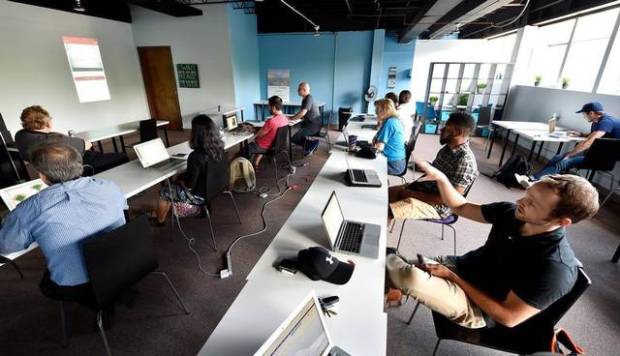
These are precisely the type of students who attend the Disruption Institute, according to Michael Gelphman, founder of the Kansas City coding school.

The Disruption Institute teaches mobile application development in a 10-week course for a $6,000 tuition fee. Its second class, a group of 10, finished its course last Thursday.

Gelphman, who is also the founder of Kansas City IT Professionals, decided to launch the Disruption Institute in 2013 when he noticed the need to fill tech jobs in Kansas City.

“When you talk about skill sets, there are certain requirements that get in the way,” Gelphman said. “But if somebody is motivated … then companies will give them a chance and allow them to build up their skill set and build a career.”

The Disruption Institute is still new and relatively small, and it has experienced some growing pains already. For instance, the coding school has lost some teachers to other companies, which made it tough to hit the ground running.

But Gelphman is already seeing some success stories — one graduate now creates apps for IBM in Chicago — and the Disruption Institute’s third course will begin in early September.

You’re hired — maybe

But when it comes to these new education pathways, quality of schooling and job placement are not guaranteed.

People interested in short-term courses should be discerning, Weber said. The best teachers have professional experience, and the curriculum should prioritize real-world projects and working in teams.

In addition, although startups are generally willing to invest in applicants from these programs, larger businesses may be more hesitant to hire applicants without a degree, according to Fein.

It’s important to remember, Weber said, that while this sector is growing at a rapid pace, it’s still in its nascent stages.

“We need way more of these programs and these alternative education schools to compete as a technology hub,” Weber said.

Hispanic ministry celebrating 15 years in Jefferson City

Jefferson City News Tribune | Oct 25, 2014

Divine inspiration can appear in strange places.

Sister Peggy Bonnot found hers in a hair salon in 1998. Her hairdresser shared how she had found a Hispanic girl about 3 years old outside her office the previous day. The child was wandering alone on the sidewalk.

The lost child could not speak English, so with the Spanish the hairdresser could remember from living in San Diego, she helped the girl find her home and mother.

As Bonnot listened to the hairdresser’s story, she came to a realization: a Hispanic community was sprouting in Jefferson City.

A few months later, Monsignor Don Lammers, then a priest at St. Peter Catholic Church, announced the parish would be ordering Spanish ritual books for Spanish-language masses.

“I told him I was interested in that because the foundation of my community was from San Antonio, Texas, and we have a whole province of sisters in Mexico,” Bonnot said. “I felt like that was a direct call to our community. So I talked to two more sisters … and the three of us got together, and we wrote a grant. And the rest is pretty much history.”

Bonnot and two other Sisters of the Charity of the Incarnate Word founded El Puente in 1999. Today, the ministry will celebrate 15 years of service.

El Puente, the Spanish word for “bridge,” is an apt name. It aims to help 700-800 Spanish-speaking families bridge the gap between the two worlds of Latin America and the United States, said Bonnot, who is now executive director of the ministry.

When El Puente began, it offered Spanish Masses to a modest 100 families in Jefferson City and California, Missouri. Families immigrated to Missouri from numerous countries, including Mexico, El Salvador and Guatemala. According to Bonnot, they left home countries with a dearth of opportunity but, often, an excess of violence.

“When I was studying Spanish in Mexico, at that time the median age was 19. And so they needed a million new jobs every year to provide for their citizens. So the opportunity was just not there in many instances,” said Bonnot, who studied with a language immersion program in Guadalajara in 2000.

Immigrants came to Missouri to find peace and calm, and El Puente was happy to help.

Within the first year, the organization not only facilitated Spanish Masses, but it responded to calls to help immigrants with medical and legal appointments. Soon enough, El Puente offered services in immigration work, language tutoring, mentoring, helping with social and economic needs, and sponsoring traditional celebrations.

These days, El Puente has a staff of six and several volunteers. They’ve moved into a renovated house on McCarty Street, decorated with Peruvian paintings and portraits Our Lady of Guadalupe sitting atop the fireplaces.

In August, El Puente officially added “Hispanic Ministry” to the end of its name and became a registered non-profit with the state of Missouri.

“I want El Puente to continue to be that bridge for people, to help people to grow to independence, so they can navigate on their own, and so they can fulfill their dreams,” Bonnot said.

UPDATE: Missouri laboratory certified to test for Ebola

Columbia Missourian | Oct 17, 2014

JEFFERSON CITY — As news of potential Ebola cases captivates the nation, Gov. Jay Nixon assured Missouri residents Friday that the state’s health network was prepared to handle possible cases. Missouri now has one of approximately 20 laboratories across the country that can test potential Ebola specimens.

“What we tried to do is be consistent, to be prepared, to be calm and to be vigilant,” Nixon said during a press conference at the Missouri State Public Health Laboratory in Jefferson City. “We hope that gives fellow Missouri residents confidence that we have a public health system … that is on point and prepared. And should the need arise, we have the resources to adequately deal with the challenge.”

The Centers for Disease Control and Prevention has certified the Missouri State Public Health Laboratory as an Ebola testing laboratory in order to investigate and control the disease in the state. Although the lab has received all proper equipment and protective garb, it has not yet received any Ebola samples, said Gail Vasterling, director of the Missouri Department of Health and Senior Services.

“There’s not been a single reported case of Ebola in the state of Missouri,” Nixon said. “Our lab is as good as any anywhere and has been certified to make sure that we will be able to find out as quickly and as professionally as possible if (an Ebola case) occurs.”

Nixon also announced Friday the release of $3.3 million in funds to local health agencies to combat this and other health concerns, such as the flu and foodborne illnesses.

After the Oct. 8 death of the first person to be diagnosed with Ebola in the United States and the subsequent spread of the disease to two nurses, some have raised concerns about the thoroughness of CDC protective standards.

However, Vasterling said that the Missouri health care system has been properly trained in how to respond in the event of an Ebola case. She said hospitals statewide have been following CDC guidelines on protective gear and protocol.

“We had a training session last week with hospitals, emergency management systems, law enforcement, schools, and we had our state epidemiologist do a presentation for all of them. And then they did an exercise,” Vasterling said. “We’re planning to do more of those regionally. We also send out health alerts to update all the medical community within the state when necessary about the Ebola issue.”

The number of people who have contracted Ebola in the U.S. is small in comparison to those in West Africa. According to the CDC’s most recent estimates, West African countries have seen 8,973 cases of Ebola and 4,484 deaths. The continuing outbreak has been blamed on widespread poverty and failing infrastructure of the health care systems in the affected area.

Both Nixon and Vasterling reassured Missouri residents that similar failures are not a part of the state’s health care system.

Ebola is spread through direct contact of bodily fluids, including vomit, semen, sweat and blood. Those who suspect that they have Ebola should contact their local public health agencies.

VETO SESSION: Abortion wait time expected to be hot topic

Columbia Missourian | Sept 10, 2014

JEFFERSON CITY — One of the legislature’s most emotionally charged debates in the veto session, which begins Wednesday, is likely to surround a bill that would triple the wait time for women having an abortion in Missouri.

Currently, that wait time is 24 hours. Advocates of the bill say that women need 72 hours to make an informed decision. Opponents respond that 72 hours of waiting only prolongs the woman’s pain.

For Liz Read-Katz, a Columbia resident and stay-at-home mother who had an abortion in 2011, the notion that 72 hours is beneficial for reflection is misguided.

Read-Katz was 16 weeks pregnant when she learned that her child had a 10 percent chance of having Trisomy 18, a chromosomal defect that few infants survive past birth.

After an amniocentesis confirmed the diagnosis, her doctor told her that the child would know only a short life of suffering. Read-Katz decided to terminate her pregnancy.

Read-Katz was living in Texas at the time. Although Texas has a 24-hour waiting period, she had to wait two weeks while her doctor petitioned the ethics board to allow the abortion at her Christian hospital.

“Waiting has zero impact on women. Once they’ve made the decision, they’ve already thought about it for a lot longer than 72 hours,” Read-Katz said. “No woman wants to have an abortion. They do it because they need to. The only thing a waiting period does is makes the woman hurt more and for longer, emotionally and physically.”

Read-Katz recalled that during her two-week wait, people asked her on a daily basis when her child was due, or whether she would be giving birth to a boy or a girl.

Three years later, House Bill 1307 appeared in the Missouri legislature.  The bill aimed to extend the time between a woman’s initial meeting with the abortion provider and the procedure from 24 hours to 72 hours. The 72-hour period would include no exceptions for victims of rape or incest. The bill passed in the House by a vote of 111-39, and it passed in the Senate 22-9.

In July, Gov. Jay Nixon vetoed the bill.

As it stands now, Missouri law requires that physicians offer women literature on the risks of the procedure and abortion alternatives, including printed materials that “prominently display the following statement: ‘The life of each human being begins at conception. Abortion will terminate the life of a separate, unique, living human being.’”

The physician must also provide the opportunity for women to view an ultrasound, although they are not required to do so. Women must then wait 24 hours before they can give their consent to go through with the procedure.

Extending the wait period to 72 hours would allow women more time to consider all of the information given upon the initial meeting, said Rep. Kevin Elmer, R-Nixa, sponsor of House Bill 1307. Elmer based his bill on the laws of two other states — Utah and South Dakota — that require women to wait 72 hours before an abortion.

The states implemented their laws too recently for statistics on these laws’ effects to be available. However, Dina van der Zalm, volunteer and former legislative intern for Planned Parenthood in Columbia, said she would be cautious of these figures, regardless.

Missouri has one abortion clinic in St. Louis, but van der Zalm said that some women travel to abortion clinics in other states, such as the one in Overland Park, Kan., near Kansas City. Women who opt to receive their abortions in other states will skew the statistics and conclusions drawn from them, van der Zalm said.

“Women have the choice to take all the time they want, but mandating a 72-hour wait increases the economic and emotional burden on women, even more so if they are juggling work schedules and childcare,” van der Zalm said.

Susan Klein, legislative liaison for Missouri Right to Life, sees the wait time as beneficial rather than burdensome.

“When a woman is in a crisis situation, it’s good to reflect on this decision. It’s going to take the life of an innocent child,” Klein said. “On Sept. 10, we’re going to be around to protect those innocent little lives.”

Klein is part of the anti-abortion advocacy groups hosting a #ShowMeLife rally and prayer vigil at the Capitol steps on Wednesday, the first day of the veto session. The groups are confident that the veto will be overturned. In fact, the groups have already scheduled a victory celebration rally for 4 p.m. Wednesday on the Capitol steps.

Read-Katz shared her story on the state Capitol steps in May during a filibuster sponsored by activists, and she plans to be back in Jefferson City on Wednesday to participate in another rally. The Stand With Missouri Women Rally was organized by a coalition of Missouri groups including Planned Parenthood and the American Civil Liberties Union.

The vote to override Nixon’s veto is scheduled for Wednesday. The #ShowMeLife rally will be at noon at the Capitol Rotunda, and the Stand With Missouri Women Rally will begin at 11 a.m. at the state Capitol.

Sporting Innovations sues ex-CEO, saying he plotted to form a rival

allison young
Photo Credit: Allison Young

Kansas City Star | June 23, 2015

Sporting Innovations is suing former co-CEO Asim Pasha for allegedly plotting to create a competing company by using the firm’s resources, business relationships, confidential information and trade secrets.

In addition, the lawsuit alleges that Pasha spent tens of thousands of dollars of Sporting Innovations’ money for personal use.

Sporting Innovations fired Pasha on June 16 and the day after filed its lawsuit with the U.S. District Court of Western Missouri. Pasha’s son, Zain Pasha, a product manager for the company, was sued as a co-conspirator.

Sporting Innovations alleges that Asim and Zain Pasha violated the Computer Fraud and Abuse Act and breached the company’s contract. Neither Asim nor Zain Pasha was available Tuesday for comment. Sporting Innovations also had no comment.

Asim Pasha helped found Sporting Innovations in 2011 as an offshoot of the soccer club Sporting KC. He was Sporting KC’s chief information officer and chief architect before being named co-CEO of Sporting Innovations, which works with sports teams and venues on improving fans’ experiences at games.

Sporting KC co-owner Robb Heineman is now the sole CEO at Sporting Innovations.

According to the lawsuit, which seeks $75,000 in damages, Asim and Zain Pasha spent the past year colluding with a New York consulting firm to create a company called Knowledge Works.

Sporting Innovations began working with the New York firm Vernalis Group Inc. in late 2013.

But the lawsuit alleges that in the summer of 2014, Asim Pasha took steps to shift all decision-making power regarding Vernalis to himself, including removing other executives’ network and administrative access.

The lawsuit says that in September 2014, Vernalis began sending more frequent invoices to Sporting Innovations, although Vernalis did not provide details about the content of its work. The suit claims that this was when Asim and Zain Pasha initiated confidential conversations with Nader Hanafy, managing director at Vernalis.

Sporting Innovations has also filed suit against Vernalis Group and Hanafy. Hanafy did not respond to requests for comment.

According to the lawsuit, the Pashas deleted many of their communications with each other and Vernalis, but they did leave some scraps of correspondence behind.

On Sept. 29, the lawsuit says, two isolated lines from their Gmail chat remained undeleted. One line, sent from Asim to Zain, said, “and then actual expenses we siphon.” Asim sent another message half an hour later that said, “Delete hangout from phone.”

On March 16, Zain Pasha resigned from Sporting Innovations, but he refused to sit for an exit interview or return his company laptop, which the lawsuit says contains confidential company and trade secret information.

Around the same time, the lawsuit says, Asim Pasha began ignoring emails confronting him about tens of thousands of dollars he had charged on the company credit card.

After three months, Sporting Innovations fired Asim Pasha. Like his son, the suit says, he still has his company laptop.

Sporting Innovations is known for its inventive approaches in boosting fan engagement. Earlier this year it made headlines for being named one of Fast Company’s most innovative companies for sports. Asim Pasha, too, received honors as one of Sports Business Daily’s 50 most influential people in sports business in 2013. Previously Pasha worked for Cerner Corp., whose co-founders Cliff Illig and Neal Patterson are owners of Sporting KC.

Boulevard Brewing owner adds California brewer Firestone Walker

boulevard-karla mock
Photo Credit: Karla Mock

Kansas City Star | July 15, 2015

Duvel Moortgat, the Belgian brewing company that bought Kansas City-based Boulevard Brewing in 2013, has combined with Firestone Walker Brewing Co.

Firestone Walker is a specialty brewer in Paso Robles, Calif., that distributes its beer in 21 states, including Missouri. The beer can be found in the Kansas City area.

Duvel Moortgat and Firestone Walker are private companies, and no financial details were released. But it appears that the two companies will combine their business efforts while operating independently.

“The partnership will allow Firestone Walker to develop our capacity in the U.S. in a conservative and thoughtful way,” Firestone Walker co-founders David Walker and Adam Firestone said in a statement.

Duvel Moortgat’s U.S. operations are projected to produce 270,000 barrels this year, with 200,000 of those barrels brewed through Boulevard. Firestone Walker’s brewing capacity is slightly larger, with projected production at 275,00 barrels in 2015.

Worldwide, Duvel Moortgat produces 1.3 million barrels through five craft breweries in Europe and now three in the U.S., including Firestone Walker and Brewery Ommegang in Cooperstown, N.Y.

“This is about more than finding financial help,” said Simon Thorpe, CEO of Duvel Moortgat USA. Rather, Thorpe said, it’s about craft brewing companies helping each other out and accelerating investments, such as Duvel Moortgat’s investment in Kansas City.

Firestone Walker is family owned. Adam Firestone, great-grandson of the founder of Firestone Tire and Rubber Co., founded the brewery in 1996 with Walker, his brother-in-law.