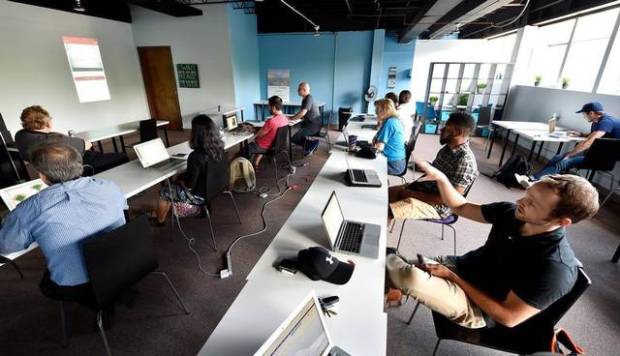
Virtual reality technology expands to a blitz of uses, including football

Virtual Reality BIZ al 0617.jpeg

Photo Credit: Allison Long

Kansas City Star | 24 June 2015

You slip a smartphone into a pair of clunky goggles and place them on your head. The room around you dissolves and you’re standing on a grassy field behind a lineup of football players. You hear the crowd’s cheers.

It’s time to play football.

Sure, the football players look more like video game characters than real people. And you’re not physically running on a field, nor do you have a football in your hand. Those goggles, a lightweight virtual headset, are your only equipment. You control the play with your eyes, deciding when to snap and where to throw.

This virtual reality program — which some call VR — is not a video game. It’s a football training tool.

“With this technology, you can do four plays in a minute. Cool!” said Brendan Reilly, CEO of Eon Sports, a Kansas City startup company that produces the training program.

Because players work on mental reps in this simulation rather than engaging in physical play, this simulation could also lower the rate of injuries, including concussions.

Reilly’s football software is among a tidal wave of VR programs being developed for introduction to consumers in the next year. The military already uses VR in some training exercises, but the technology has potential uses in other areas, such as entertainment and home improvement. Architects, for instance, can create life-size virtual models of buildings rather than relying on traditional physical models.

Last week, several companies gathered at the Electronic Entertainment Expo, or E3, in Los Angeles to show off their products. A few are being sold already, such as the $200 Samsung Gear VR headset, compatible only with Samsung smartphones. Other devices and programs are still in production as developers put on the final touches.

HTC will begin selling its virtual reality headset, Vive by Valve, by the end of this year, and Oculus will follow suit with the Oculus Rift in early 2016. Sony is expected to release its own headset, Project Morpheus for PlayStation 4, around the same time. Prices have not been announced for these devices, but analysts predict they’ll be more than a few hundred dollars.

The rise of virtual reality

When Reilly was a graduate assistant in 2010 to then Illinois State University basketball coach Tim Jankovich, the coach joked that he would fire him if he didn’t turn his idea for a VR sports training system into reality. Reilly graduated with a master’s degree, headed to California and became the CEO of a joint venture of Eon Reality and Eon Sports.

Now Reilly, who grew up in the Kansas City area, is back in town. Eon has created Sidekiq software that trains football teams with programs ranging in price from $39 to $999. He delivered his first product last year and has sold programs to almost 1,000 consumers, high school teams and college teams such as UCLA and Ole Miss.

“I had no idea how scalable this was going to become,” Reilly said. “Five years in virtual reality land is like 50 in the real world — it’s like dog years. It’s been crazy to watch this industry evolve and grow.”

Over the past few years, increasing numbers of established companies and startups have turned to VR. At the E3 conference, companies touted virtual reality as the imminent next step in gaming technology. Whether it catches on with consumers, though, is unclear.

“Not everyone’s going to want one,” said Brian Blau, a research director in personal technologies at Gartner.

Not everyone will want one immediately, at least.

Virtual reality programs are now directed toward hard-core gamers, a demographic that skews heavily toward millennial males. In addition, more sophisticated VR programs require a game console, which not everyone has.

This isn’t the first time virtual reality has caused ripples of excitement in the tech community, nor is it the first time doubts have surrounded its success. Twenty years ago, scientists and gamers were overflowing with the hype surrounding virtual reality, but that anticipation eventually ebbed. The technology simply hadn’t caught up with the grand ideas.

This time around, developers feel optimistic that technological development has finally aligned with the ambition of the 1990s.

When Facebook reeled in Oculus, one of the biggest fish in VR, with a $2 billion acquisition in March 2014, the deal sounded a “bugle call” for the industry, said Skip Rizzo, a research professor at the Institute for Creative Technologies at the University of Southern California. Oculus had humble beginnings, raising money from donors online. But under the ownership of Facebook, Oculus now hopes to push VR into the mainstream marketplace.

After the Oculus-Facebook deal, “companies and devices began popping up everywhere,” Rizzo said. “It was like the Wild West.”

Those startups will continue to appear in the next two years, which Rizzo predicts will yield both wreckage and survivors.

Device prices start high, but Rizzo is convinced that costs will drop in the next few years, especially with virtual reality applications that rely on mobile devices rather than expensive, bulky consoles.

“Everyone will have a headset in their home,” Rizzo said. “They’ll be like toasters.”

VR in the marketplace: The desert of the real?

Not everyone is convinced of the toaster theory.

“With virtual reality, developers are making a very big leap,” Blau said. “Developers may make killer apps that draw people in, or they might not.”

Raymond Wong, a product analyst for Mashable, said: “I’m not sure if people want to put these goggles on at home. It’s a very isolating experience.”

Indeed, total immersion in a world that occupies most of the users’ senses could lend itself to previously unseen consequences.

Regis Kopper, director of the Duke Immersive Virtual Environment at Duke University, is concerned with how people make sense of their physical surroundings in a virtual space.

“When you wear a head-mounted display, you don’t have your own body,” he said. “In the physical world, your body is an anchor, and you lose that in virtual reality. How do you re-create touching your leg in virtual reality?”

It’s one of many big questions VR researchers must confront. Simulation sickness is another. While many users’ senses are occupied by the virtual world, other senses are left behind in the physical world. This discrepancy can cause a motion sickness similar to the feeling of reading a book on a bumpy train.

Researchers are investigating sometimes unexpected ways to combat simulation sickness. Scientists at Purdue, for instance, found that adding a 3-D nose to VR programs reduced symptoms of sickness.

Simulacra and simulations

Wong sees more potential for VR in commercial industries such as marketing or engineering.

Research has already pointed to VR’s advantages in the medical field, Rizzo said. Once interactive intelligent agents — virtual characters — are advanced enough to respond like people, surgeons in training may be able to practice procedures with these characters. VR simulations could also be used as a way to distract patients from painful procedures, possibly becoming an alternative to pain medicine.

Education may also benefit from advances in virtual reality.

If a student struggles with conceptualizing the atomic structure, for instance, he could plop on the headset and be immersed within a virtual atom.

As companies sell, developers invent and gamers play, one philosophical uncertainty looms over the industry: How will virtual reality alter human interaction?

It’s a tricky question.

“Social interaction in virtual reality is a double-edged sword,” said Jeremy Bailenson, director of Stanford University’s Virtual Human Interaction Lab. “On the one hand, networked avatars allow us to ‘be with’ anyone, anywhere, anytime. … On the other hand, as we rely more and more on virtual interactions, the very nature of what it means to be social changes.”

Different media powered by wireless connections have already transformed certain types of communication. Several researchers say virtual reality is just another medium.

“But since it will engage more human senses, there is the potential for more problems,” Kopper said. “People might not be inclined to socialize as much. They might get drawn into the VR simulation.”

David Whittinghill, an assistant professor at Purdue, isn’t convinced. He predicts that simulation sickness will limit how long one person can stay within a virtual world. In that sense, real life is still more appealing than virtual life.

For many virtual reality developers, though, the utility of VR technologies outweighs the risk of uncertain circumstances.

Back in Kansas City, Reilly had trouble containing his excitement for the possibilities of his company’s future.

“The dream is that I’m a kid in Seattle and I’m playing against a kid in Kansas City. And we’re on our own physical fields playing these holographic guys,” he said. “That gets my geek juices going. And it’s becoming more and more realistic.”
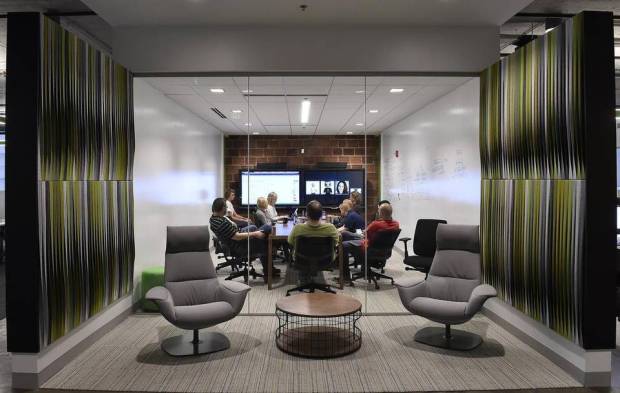

Homegrown consulting firm Valorem uses the cloud to bloom

Kansas City Star | 28 July 2015

Valorem BZ 072015 JAT 007F.jpeg

Photo Credit: Jill Toyoshiba

A giant sea turtle hangs from the ceiling in Valorem’s headquarters in the Crossroads Arts District.

It was the most valuable prize available at PowerPlay, a game center where visitors use points to claim items. Valorem employees took it with them after they pooled their points at the end of a company outing.

PowerPlay workers had to climb a ladder to retrieve it and vacuumed the dust that had piled on top. Nobody had touched the sea turtle since the store opened.

Now the sea turtle rests in its net, a trophy for Valorem and an apt metaphor for how the technology company aims high and uses teamwork to help big-fish clientele.

Managing partner Domnick Parretta put it simply: “Companies hire us to solve a problem.”

The 6-year-old business has grabbed the attention of the tech community, both locally and nationally, for its speedy growth.

“They’ve scaled their company extremely quickly,” said Ryan Weber, president of KCNext. “They’re really a tech victory for Kansas City.”

Valorem Consulting Group LLC has about 115 companies in its client base, almost double its 60 clients at the end of last year. Those clients are generally national corporations or large business enterprises in Kansas City or Washington state. Valorem has beat out larger competitors such as Dell and Accenture to work with the likes of Alaska Airlines and Post Foods.

When Valorem started in 2009, the company’s founders, Parretta and fellow managing partner Justin Jackson — both from the area and then in their 20s — worked out of home offices in Kansas City and St. Louis.

Two years later, the company had 20 employees who bought cots and slept in the office for days at a time to finish projects.

But that was “two offices ago,” in Parretta’s words. The company now has 120 employees and, after expanding into another floor at its Crossroads location, it’s expanding again. Valorem plans to hire 30 more people to tackle more business before the end of the year.

Valorem’s burgeoning success is fueled by two main ingredients: its cloud-based technology services and its partnership with Microsoft.

Many consulting companies are heading toward the cloud, a way to access and store data from different devices, Weber said. It’s cheaper for the consulting agency and the client because the cloud cuts expenses that come with new hardware.

But what really attracts clients, Weber said, is Valorem’s partnership with Microsoft.

“Valorem is so focused on Microsoft products, which makes them unique in the field,” Weber said.

Valorem has carved a niche for itself in the consulting industry by immersing itself in Microsoft. It’s become an expert by learning about Microsoft products and engagement at a granular level, Parretta said.

In fact, Microsoft has actually hired Valorem for several consulting products.

When Microsoft asked Valorem to develop a more user-friendly way for its corporate business customers to interact with Office 365, Valorem consultants researched the program and profiled Microsoft customers. Soon they had built a Web tool.

“We helped create a dynamically generated website that has a communications engine built in,” Parretta said.

Last spring, Valorem built tools to interpret data gathered by Yammer, an internal company social media platform acquired by Microsoft in 2012.

Valorem consultants developed ways to quantify how employees use their downtime and tools to read employee sentiment by data gathered from posts. If a big company decision is announced on Yammer, for instance, employees can give their feedback. The company can then analyze those responses and determine whether employee sentiment is largely negative or positive.

The company’s consultants also use Microsoft products to solve problems for other companies. Right now, they are considering Microsoft HoloLens, an augmented reality device, to help clients in manufacturing and retail use holograms to visualize and improve procedures and processes.

But seven years ago, Parretta and Jackson struggled to solve a problem of their own: finding a name.

“We’re literally brainlocked. It’s a damning statement, right? We can’t solve our own problem!” joked Parretta.

They settled on the Latin word for value, Parretta said, because Valorem’s mission is to add value for its customers.

As Valorem has expanded, it has experienced growing pains in areas such as scouting and hiring talent.

“We identify what we call the synthesizer gene,” Parretta said. “We actually measure this gene to see how well you synthesize seemingly disparate pieces of information to pull them together to make a solution.”

Despite the challenges, Valorem has managed to expand its workforce and workplace. And its Crossroads offices have their merits: The exposed brick of the renovated factory building. The spray-painted patterned art, commissioned by Valorem, by local graffiti artist Sike. A pingpong table next to a kitchen filled with healthy snacks. And a treadmill desk, available to employees who don’t want to give up their exercise routine for work.

It’s all part of the effort to attract driven employees and to keep the workforce productive and healthy.

The company doesn’t intend to stop growing any time soon. It is preparing to expand its Kansas City headquarters as well as its current Seattle and St. Louis offices, establish locations in Chicago and Dallas, and eventually set up in Europe, south Asia or South America.

Parretta is convinced that the company can accomplish these goals in the next two to three years.

“They sound pretty ambitious,” said Parretta. “But if you would have told me we’d be where we are right now six years ago, I’d have told you that you were too ambitious.”

Women in the Kansas City tech industry aim to boost their numbers

Kansas City Star | 12 August 2015

Alphapointe camp teaches visually impaired children how to use technology

alphapoint

Kansas City Star | 30 July 2015

For the visually impaired, technology can swing a wrecking ball at barriers in a world built for those with 20/20 vision.

But if people lack proper training on how to use technological devices, their utility is lost.

That’s precisely the reason for the Alphapointe Technology Camp, a weeklong program for visually impaired kids in middle and high school that ends Friday.

Alphapointe, a nonprofit organization that helps those with visual impairment, teamed up with Sprint and Samsung to teach children how to operate electronic tablets. Students learn about various applications and features that can make school more accessible when they return to classrooms next month.

“We’re coming up with different applications to help with documentation, writing papers, keeping organized,” said Krista Mankae, an instructor at the camp. “But at the same time, we’re showing them those accessibility features that can magnify and navigate (and) talkback features that can help with kids who have visual impairment on a tablet.”

For instance, reading the whiteboard is a task that most students take for granted, but it’s a major hurdle for kids who have trouble with sight. One application can scan a photo of a whiteboard and then “talk” to the tablet user, telling the student what it “sees” on the screen.

It’s the fifth year of the camp, and it’s the second year Samsung has partnered with Alphapointe.

Samsung provided the tablets, which students keep after camp is over. Samsung representatives observe kids as they navigate the devices, hoping to learn how to improve apps and tablet design for visually impaired users.

The 24 enrolled students are grouped into two rooms.

Blind children share a table in one conference room, which is filled with the sounds of students telling commands to their tablets and the “dinging” of a touch-tone Braille keyboard.

The second room is larger and used by students who have some sight. The students in this room are a boisterous bunch, teasing the instructors and joking among themselves.

“Alpha!” shouts the instructor when he needs to nab the students’ focus.

“Pointe!” the kids shout back and then fall into a mostly attentive silence.

This is the room where 12-year-old Amiah Washington from Knob Noster, Mo., decided to develop her own apps.

She learned how certain features on the tablet make it more accessible to use — for her, black and orange colors are easiest to read, especially when the letters are blown up to a larger size on the screen — and she was inspired.

“If you’re sending a text message, you can move your fingers in and out … and change the font in the text,” Amiah said, imagining how she might make the tablet more manageable.

She has other ideas, such as adding photographs of landmarks and destinations to electronic maps.

“I’ve had experiences with the tablet before,” Amiah said. “But now I know how to work this tablet, and I feel smarter.”

Coding schools offer a fast-track shot at information technology jobs and aim to fill skill gaps

rich sugg coding
Photo Credit: Rich Sugg

Kansas City Star | July 29, 2015

When President Barack Obama in March announced his federal TechHire initiative, a program meant to help fill the huge number of vacant technology jobs in the U.S., he honored bus driver turned computer programmer LaShana Lewis.

While growing up under the poverty line in East St. Louis, Ill., Lewis realized she had an interest in coding. She attended Michigan Technical University to study computer science, but she left after three and a half years — just before graduation — because she didn’t have the money. After that, she drove buses and worked at help desks.

“I had the skills,” Lewis said. “I had taken the programming classes. But I didn’t have a degree.”

Then she heard about LaunchCode, a two-year-old nonprofit organization that places apprentices with companies ranging from large corporations to small startups. It’s one program in a growing industry that equips people with tech skills in months, even weeks.

Lewis applied last fall, became an apprentice at MasterCard and was quickly hired full time.

LaunchCode, based in St. Louis, will expand to Kansas City this winter, and it’s not the only program of its type headed this way.

At the root of efforts like LaunchCode, the tech industry needs to fill jobs.

In Kansas City, more than 2,000 technology jobs are vacant. Nationally, that number jumps to half a million, according to the White House.

That figure will continue to grow if the tech sector does not give potential employees the special skills needed to fill these jobs, said Ryan Weber, president of KCNext.

“The demand for coding developers is off the charts,” said John Fein, managing director for TechStars at Kansas City’s Sprint Accelerator.

New players in the education industry promise to solve this equation. Compared to traditional four-year degree programs, these courses teach tech skills through boot camps, coding schools and apprenticeships in under a year.

These groups are multiplying — the sector predicts there will be more than 16,000 graduates of the alternative tech programs in 2015, compared to 6,740 last year — and some are popping up in Kansas City.

“There’s been a lot of discussion and talks from various groups because there’s a lot of opportunity here,” said Weber.

Earlier this summer, LaunchCode received a $250,000 grant from the Missouri Technology Corporation to expand to Kansas City. Since then, LaunchCode has raised $500,000 for the expansion and hopes to find $1 million in funds by fall.

LaunchCode, which also operates in Miami, is betting on finding 60 Kansas City partner companies.

Many other tech education programs are making the same move to Kansas City, Weber said. Plus, job placement company Paige Technologies is developing a tech boot camp that will launch in the fall.

Empowerment by closing the skills gap

LaunchCode is free for apprentices. The company makes its money by charging companies $5,000 for each job placement. More than 90 percent of candidates placed in apprenticeships are ultimately hired full time.

This is good news for people who come from underprivileged backgrounds and lack the financial means or time to invest in a four-year degree.

Forty percent of candidates who enter the program are unemployed, and 42 percent are underemployed with salaries under $25,000. The average starting wage of LaunchCode candidates who finish their apprenticeships, however, is $50,000 — a doubling in wages.

But empowering those who need it most is tricky.

Since LaunchCode was founded, 37 percent of its participants are minorities. This is much lower than St. Louis’ minority population, which makes up 53.6 percent of the city’s residents, according to the U.S. Census Bureau.

In addition, only 26 percent of LaunchCode’s candidates are women. This is about on par with the national rate of women in computing jobs, indicating a dearth of women in the technology industry.

Most coding schools and boot camps charge tuition. The national average price of tuition is $11,063, according to the Course Report. But since these programs are not publicly funded or accredited, they cannot offer federal aid or loans.

Leawood-based training company Centriq, for instance, charges students an average of $20,000 for its four-month courses in application development and network administration.

Centriq does offer private loans, but company president Kevin Grawe said even students who pay the full price upfront will see a quick return on their tuition investment.

More than 90 percent of graduates find jobs in IT, Grawe said, and they are hired with an average starting salary of $41,000 to $45,000.

Nontraditional

In fact, most people taking advantage of alternative education programs are not from underprivileged communities.

Rather, the two largest demographic student sectors are professionals learning new skills to switch careers and military veterans returning to the workforce.

These technology programs are particularly useful to these groups of people, who may not want to invest in four more years of education.

Even Kevin Truman, dean of UMKC’s School of Computer and Engineering, said the industry should have alternative paths to finding jobs in technology.

“In STEM (science, technology, engineering and mathematics) industries, there are all sorts of points of entry,” Truman said. “It’s good to have these different schools.”

These are precisely the type of students who attend the Disruption Institute, according to Michael Gelphman, founder of the Kansas City coding school.

The Disruption Institute teaches mobile application development in a 10-week course for a $6,000 tuition fee. Its second class, a group of 10, finished its course last Thursday.

Gelphman, who is also the founder of Kansas City IT Professionals, decided to launch the Disruption Institute in 2013 when he noticed the need to fill tech jobs in Kansas City.

“When you talk about skill sets, there are certain requirements that get in the way,” Gelphman said. “But if somebody is motivated … then companies will give them a chance and allow them to build up their skill set and build a career.”

The Disruption Institute is still new and relatively small, and it has experienced some growing pains already. For instance, the coding school has lost some teachers to other companies, which made it tough to hit the ground running.

But Gelphman is already seeing some success stories — one graduate now creates apps for IBM in Chicago — and the Disruption Institute’s third course will begin in early September.

You’re hired — maybe

But when it comes to these new education pathways, quality of schooling and job placement are not guaranteed.

People interested in short-term courses should be discerning, Weber said. The best teachers have professional experience, and the curriculum should prioritize real-world projects and working in teams.

In addition, although startups are generally willing to invest in applicants from these programs, larger businesses may be more hesitant to hire applicants without a degree, according to Fein.

It’s important to remember, Weber said, that while this sector is growing at a rapid pace, it’s still in its nascent stages.

“We need way more of these programs and these alternative education schools to compete as a technology hub,” Weber said.